
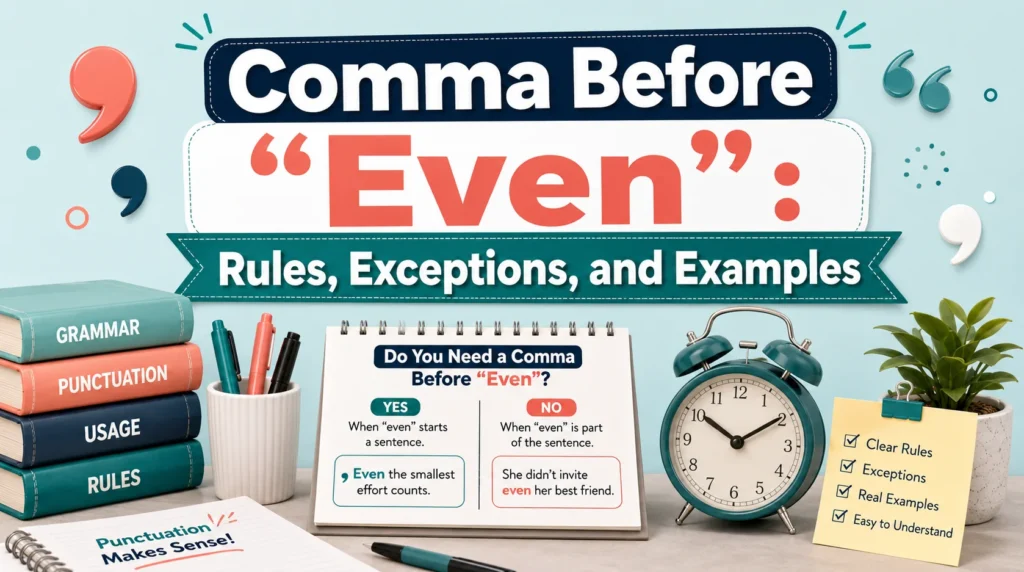
When I teach Comma Before “Even”, learners often struggle with punctuation, grammar, and usage because English rules feel contradicting in article writing, yet clear context improves clarity in communication.
From my experience, using a comma before even depends on list, adjectives, and parenthetical cases like tricky-comma-phrases and tricky-sentence-structure, where rule application ensures smooth flow, correct formatting, and better interpretation.
I always apply simple guidelines instead of overthinking; a decision to use it in language or expression improves clarity, precision, and makes writing easier for the reader in real communication.
Quick Answer: Do You Put a Comma Before “Even”?
Here’s the short answer:
You usually don’t put a comma directly before “even” unless the sentence structure requires one.
The comma normally belongs to the clause, phrase, or parenthetical expression around even, not to the word itself.
Quick Examples
| Sentence | Correct? | Reason |
| Even my brother enjoyed the movie. | ✅ Yes | No comma needed. |
| Even though it rained, we went hiking. | ✅ Yes | Introductory clause requires a comma. |
| We went hiking, even though it rained. | ✅ Yes | Dependent clause follows the main clause. |
| I, even, liked the movie. | ❌ No | Unnecessary commas. |
What Does “Even” Mean in English Grammar?
The word even wears several grammatical hats. It can function as an adverb, adjective, or verb.
Understanding its job in a sentence often solves the punctuation problem immediately.
“Even” as an Adverb
This is the most common use.
As an adverb, even adds emphasis or surprise.
Examples:
- Even Sarah passed the exam.
- He didn’t even call.
- Even the experts were confused.
In these cases, even doesn’t need commas.
“Even” as an Adjective
As an adjective, even means level, smooth, equal, or balanced.
Examples:
- The table has an even surface.
- The score is even.
- The road became even after repairs.
Again, commas usually don’t appear before the word.
“Even” as a Verb
As a verb, even means to make something level.
Examples:
- They evened the ground.
- The workers evened the soil before building.
This use is much less common, but it still doesn’t automatically require commas.
The Main Rule: When You Do Not Need a Comma Before “Even”
Here’s the rule most writers need:
If even simply adds emphasis, don’t place a comma before it.
Examples
- Even I understood the instructions.
- She didn’t even apologize.
- They even invited their competitors.
The sentences work because even acts as a modifier.
Adding commas would interrupt the natural flow.
Incorrect Examples
❌ I, even, understood the instructions.
❌ She didn’t, even, apologize.
These commas create awkward pauses and confuse the reader.
Why Writers Get Confused
Many people add commas where they naturally pause while speaking.
Grammar doesn’t work that way.
A sentence may contain a speaking pause without needing punctuation.
Consider this sentence:
Even after ten years, he still remembers the event.
You may pause after “years” while speaking, but the comma exists because the introductory phrase ends there—not because of the word even.
When a Comma Comes Before “Even”
Sometimes you’ll see a comma immediately before even.
The comma usually separates clauses.
Example
She accepted the challenge, even though she was afraid.
The comma separates the independent clause from the dependent clause.
The comma isn’t there because of even.
It’s there because of the clause structure.
Another Example
The puzzle was difficult, even for experts.
Here, the phrase even for experts adds extra information.
The comma improves readability.
Comma Before “Even If”
The phrase even if introduces a condition.
Think of it as a stronger version of if.
Examples
- Even if it rains, we’ll go.
- Even if you disagree, listen first.
- Even if the project fails, valuable lessons remain.
The introductory clause takes a comma because it comes first.
When the Clause Comes Last
- We’ll go, even if it rains.
- She’ll help, even if she’s busy.
In these sentences, the comma separates the independent clause from the dependent one.
Comma Before “Even Though”
The phrase even though introduces contrast.
It functions like although, but it often adds stronger emphasis.
Examples
- Even though he was tired, he finished the report.
- Even though the price increased, customers kept buying.
Clause at the End
- She smiled, even though she was nervous.
- They won, even though nobody expected it.
The comma separates the clauses and improves readability.
Comma Before “Even When”
The phrase even when describes circumstances that remain true under certain conditions.
Examples:
- Even when life gets difficult, she remains optimistic.
- Even when the evidence was clear, he refused to change his opinion.
Final Position
- She remains optimistic, even when life gets difficult.
- He stayed calm, even when everyone panicked.
Again, the comma belongs to the clause structure.
Comma Before “Even After”
Examples:
- Even after the warning, they continued.
- Even after years of practice, he still learns new things.
Clause at the End
- They continued, even after the warning.
- She stayed hopeful, even after the disappointment.
Does the Position of “Even” Change Meaning?
Absolutely.
Moving even around the sentence changes what receives emphasis.
Sentence One
Even John passed the exam.
Meaning: John was the least expected person to pass.
Sentence Two
John even passed the exam.
Meaning: Passing the exam was surprising.
Sentence Three
John passed even the hardest exam.
Meaning: The hardest exam was included.
The word stays the same.
The meaning shifts dramatically.
Common Mistakes With Comma Before “Even”
Mistake #1: Adding Unnecessary Commas
❌ She, even, called her teacher.
✅ She even called her teacher.
Mistake #2: Forgetting the Introductory Clause Comma
❌ Even though it snowed we went outside.
✅ Even though it snowed, we went outside.
Mistake #3: Punctuating by Sound
Many writers insert commas wherever they pause.
Professional writers rely on sentence structure instead.
Quick Reference Chart
| Construction | Comma Needed? |
| Even + noun | No |
| Even + verb | No |
| Even though clause first | Yes |
| Main clause + even though clause | Usually yes |
| Even if clause first | Yes |
| Main clause + even if clause | Usually yes |
| Even for experts | Sometimes |
A Simple Trick to Remember the Rule
Ask yourself two questions:
- Is even merely adding emphasis?
- Or is it introducing a clause?
If it only adds emphasis, skip the comma.
Conclusion
Understanding Comma Before “Even” becomes easier when you focus on grammar, punctuation, and usage instead of memorising hard rules. In most cases, correct placement depends on context, sentence structure, and how clearly you want to express your meaning. When you apply simple guidelines, your writing becomes smoother, and your communication becomes more effective. The goal is not perfection but clarity for the reader, making your sentences easy to follow and interpret.
FAQs
Q1. Do I always need a comma before “even”?
No, a comma before even is not always required. It depends on context, sentence structure, and usage.
Q2. When should I use a comma before “even”?
Use it when even starts an introductory phrase or adds clarity in complex sentence structures.
Q3. Is it grammatically correct to skip the comma?
Yes, skipping the comma is often correct when even is part of the main sentence flow.
Q4. Does a comma before “even” change meaning?
Sometimes yes. It can affect emphasis, clarity, and interpretation of the sentence.
Q5. How can I learn correct usage faster?
Practice reading and writing sentences while focusing on grammar, usage, and natural communication patterns.

Sophia Moore is a Writing Coach who teaches English through real-life context, not boring theory.She develops smart mini-lessons for GrammarVerb so learners can write naturally and with precision.Her goal is to make English style clear, modern, and effective for every level.