
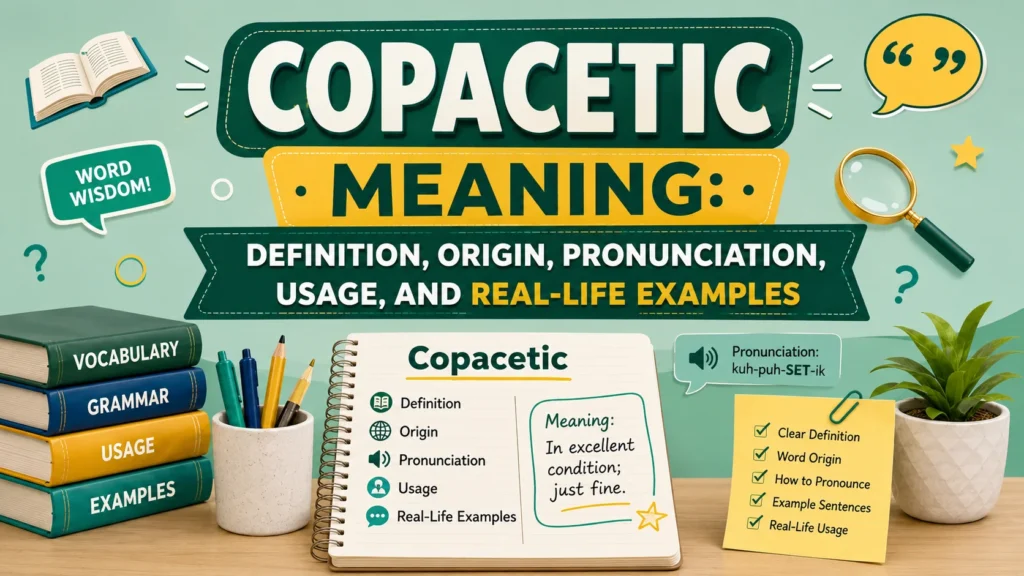
The Copacetic Meaning explains how this unusual word describes situations that are fine, balanced, and running smoothly in everyday English. When people say “Everything’s copacetic”, they show that everything is okay, in good order, and exactly how it should be. This American English expression adds personality to conversations because it is a colourful expression to describe a positive situation. The word feels unique because it carries charm, mystery, and an interesting history that makes it stand out among English words.
The origin of copacetic has a mysterious history, and linguists continue to debate where it came from. Unlike many words with clear roots, this expression keeps some mystery around its beginning. Learning how to pronounce Copacetic correctly helps people understand its pronunciation, use, and common mistakes to avoid. By comparing synonyms, similar words, and real-world examples, learners can see how this slang word works naturally in different conversations, daily language, communication, grammar, and word usage.
The quirky expression sounds cool, relaxed, and quietly confident, almost like someone wearing sunglasses while staying calm and in control. People often search for the word in a dictionary to know its real meaning, but real talk shows how it can make language more creative. The word appears in social media, classic movies, friendly chats with friends, and creative content. This 2026 complete 2026 guide shows why this satisfactory and perfectly okay vocabulary word remains naturally useful when watching, scrolling, chatting, or describing a situation where things are confidently working well.
Quick Answer: What Does Copacetic Mean?
Copacetic means everything is satisfactory, in good order, acceptable, or going well. It’s an informal American English adjective that describes situations where nothing is wrong and everything is working as expected.
Quick Facts About Copacetic
| Feature | Details |
| Meaning | Fine, satisfactory, in good order |
| Pronunciation | koh-puh-SET-ik |
| Part of Speech | Adjective |
| Tone | Informal, positive |
| Common Usage | Everyday conversations |
| First Recorded Use | Around 1919 |
| Still Used Today? | Yes, though less common than “fine” or “okay” |
Example:
“The project is finally copacetic after we fixed the last bug.”
What Does Copacetic Mean?
At its core, copacetic describes a situation where everything is working properly, acceptable, or satisfactory.
It doesn’t necessarily mean something is perfect. Instead, it suggests that things are under control and there aren’t any significant problems.
For example:
- The meeting went smoothly, so everything was copacetic.
- Once the paperwork was approved, everything became copacetic.
- After the repairs, the car was copacetic again.
The Simple Definition
Most dictionaries define copacetic as:
- Completely satisfactory
- In excellent order
- Acceptable
- Free from problems
Think of it as a more expressive alternative to saying:
- Everything’s fine.
- Everything’s okay.
- Everything’s under control.
What the Word Really Implies in Conversation
Native speakers often use copacetic to reassure someone.
Imagine you’re planning a road trip. Your friend asks if the hotel reservations, fuel, and route are ready.
You might reply:
“Yep, everything’s copacetic.”
That answer feels warmer and more colorful than simply saying “Everything’s okay.”
Is Copacetic Positive, Neutral, or Casual?
The word carries a positive tone but isn’t overly enthusiastic.
Here’s a comparison:
| Word | Strength |
| Okay | Neutral |
| Fine | Mildly positive |
| Copacetic | Clearly positive |
| Great | Very positive |
| Excellent | Extremely positive |
How to Pronounce Copacetic Correctly
Many people recognize the word before they know how to say it.
Phonetic Pronunciation
koh-puh-SET-ik
Pronounced slowly:
co • pa • SET • ic
The emphasis falls on the third syllable.
Syllable Breakdown
- Co
- pa
- SET
- ic
Common Pronunciation Mistakes
People sometimes say:
- cope-a-static ❌
- cope-setic ❌
- cop-a-tick ❌
The correct pronunciation is:
koh-puh-SET-ik ✅
Saying it naturally makes it sound much smoother in conversation.
How to Use Copacetic Naturally
Knowing the definition isn’t enough. The key is understanding when the word actually sounds natural.
Everyday Conversations
This is where copacetic shines.
Examples:
- “Everything’s copacetic now.”
- “We’re copacetic after our disagreement.”
- “The party plans are copacetic.”
Workplace Communication
Although it’s informal, many workplaces still use it casually.
Examples:
- “The client approved the proposal, so we’re copacetic.”
- “The software update is copacetic now.”
Avoid using it in highly formal reports or legal documents.
Writing vs. Speaking
You’ll hear copacetic more often in speech than in formal writing.
It appears naturally in:
- Emails between colleagues
- Friendly text messages
- Blog articles
- Interviews
- Podcasts
Situations Where It Sounds Natural
Use copacetic when:
- A problem has been solved
- Everything is running smoothly
- You want to reassure someone
- You want your language to sound a little more colorful
When You Should Avoid Using Copacetic
Like many informal expressions, copacetic isn’t appropriate everywhere.
Formal and Academic Writing
Academic essays usually favor simpler language.
Instead of:
The experiment became copacetic.
Write:
The experiment proceeded successfully.
Professional Situations Where Simpler Words Work Better
If you’re writing:
- Legal contracts
- Medical reports
- Government documents
- Research papers
Choose clearer alternatives like:
- satisfactory
- acceptable
- successful
Contexts Where Readers May Not Recognize the Word
Not everyone knows what copacetic means.
If your audience includes international readers, simpler vocabulary often communicates your point more effectively.
The Origin and History of Copacetic
One reason people love this word is its mysterious past.
First Recorded Use
Most language historians trace copacetic to American English in the early twentieth century, with printed evidence appearing around 1919.
Its popularity grew quickly in newspapers and everyday speech during the following decades.
Popular Theories About Its Origin
Several theories exist.
Some researchers believe it may have come from:
- African American Vernacular English
- Creole languages
- Yiddish influences
- Southern American dialects
Others suggest entirely different linguistic sources.
Why Its True Origin Remains Uncertain
Unlike many English words, no single explanation has been universally accepted.
That uncertainty makes copacetic one of English’s most intriguing vocabulary mysteries.
Is Copacetic Still Common Today?
Yes—but not as common as it once was.
Modern Usage in American English
Today, you’ll still hear copacetic in:
- Casual conversations
- Television dialogue
- Podcasts
- Music lyrics
- Social media posts
Regional Popularity
The word appears more frequently in the United States than in other English-speaking countries.
Older generations often recognize it immediately, while younger speakers may encounter it online or in popular culture.
Why the Word Has Survived for Decades
It has personality.
Instead of saying:
Everything is fine.
You can say:
Everything is copacetic.
The second version sounds memorable and adds character to everyday speech.
Real Examples of Copacetic in Sentences
This section provides clear, everyday examples showing how “copacetic” is used to describe situations that are satisfactory, acceptable, or in good order.
Daily Conversations
- Everything is copacetic at home now.
- We’re finally copacetic after talking things through.
- The vacation plans are completely copacetic.
Business and Workplace Examples
- The client approved every revision, so we’re copacetic.
- Our budget is copacetic for the next quarter.
- The servers are copacetic after maintenance.
School and Academic Settings
- My schedule is finally copacetic.
- The science project is copacetic now.
- Everything was copacetic before the presentation started.
Social Media and Text Messages
- “Don’t worry. Everything’s copacetic.”
- “We’re all copacetic now 😂”
Humorous and Informal Examples
- My coffee arrived, so life is officially copacetic.
- As long as there’s pizza, everything’s copacetic.
Common Collocations with Copacetic
Certain word combinations appear frequently.
Everything Is Copacetic
The most common expression.
Example:
Everything is copacetic after the update.
Things Are Copacetic
Often used after solving problems.
Keep Everything Copacetic
Means maintaining peace or order.
Example:
Let’s keep everything copacetic until the meeting ends.
Feeling Copacetic
Describes someone’s emotional state.
Example:
I’m feeling pretty copacetic today.
Copacetic Synonyms (With Differences)
Although several words share similar meanings, each has its own nuance.
| Synonym | Meaning | Best Used For |
| Fine | Acceptable | Everyday speech |
| Okay | Neutral | Informal conversations |
| Satisfactory | Meets expectations | Formal writing |
| Great | Very positive | Celebrations |
| Excellent | Outstanding | High praise |
| Hunky-dory | Everything is perfect | Informal American English |
| Peachy | Cheerful and positive | Casual speech |
| All good | No problems | Modern conversation |
Antonyms of Copacetic
Words with the opposite meaning include:
- Awful
- Terrible
- Unsatisfactory
- Problematic
- Broken
- Chaotic
- Difficult
- Unacceptable
- Messy
- Troubled
Example:
Nothing felt copacetic after the system crashed.
Copacetic vs. Similar Words
Copacetic vs. Similar Words explores how “copacetic” compares with related terms like “okay,” “fine,” and “acceptable,” highlighting their meanings, tone, and proper usage.
Copacetic vs. Fine
Fine is the safest and most common option.
Copacetic sounds more expressive and distinctive.
Copacetic vs. Okay
Okay simply means acceptable.
Copacetic suggests everything is comfortably under control.
Copacetic vs. Hunky-Dory
Both mean everything is going well.
However, hunky-dory feels even more playful.
Copacetic vs. Peachy
Peachy often conveys cheerful enthusiasm.
Copacetic focuses more on order and satisfaction.
Copacetic vs. Great
Great implies excitement or excellence.
Copacetic simply means everything is in good shape.
Is Copacetic Slang or Standard English?
Many people assume copacetic is slang.
That’s only partly true.
Dictionary Classification
Major dictionaries recognize copacetic as a legitimate English adjective.
Informal vs. Formal Usage
While it’s a standard word, it’s generally considered informal.
That means it’s perfectly acceptable in conversation but less suitable for highly formal documents.
How Native Speakers Use It Today
Most speakers use it for emphasis or personality.
Instead of repeating “fine” over and over, copacetic adds freshness to the conversation.
Grammar Rules for Using Copacetic
Understanding its grammar helps you use the word correctly.
Part of Speech
Copacetic is an adjective.
It describes a noun or follows a linking verb.
Examples:
- The situation is copacetic.
- Everything seems copacetic today.
Can It Describe People?
Yes.
Example:
She’s feeling copacetic after her vacation.
Can It Describe Situations?
Absolutely.
In fact, that’s its most common use.
Example:
The negotiations are finally copacetic.
Common Sentence Patterns
- Everything is copacetic.
- Things seem copacetic.
- The project became copacetic.
- We’re copacetic now.
Common Mistakes When Using Copacetic
Even native speakers occasionally misuse the word.
Using It in Overly Formal Documents
Stick with satisfactory or acceptable when writing official documents.
Confusing It with “Perfect”
Copacetic doesn’t necessarily mean flawless.
It simply means everything is functioning well.
Incorrect Pronunciation
Remember:
koh-puh-SET-ik
Using It Where Readers May Not Understand the Meaning
If your audience isn’t familiar with uncommon American expressions, choose a simpler alternative.
Copacetic in Popular Culture
Although it’s uncommon, copacetic regularly appears in entertainment.
Movies and Television
Screenwriters often use it to give characters a relaxed or quirky personality.
Music and Entertainment
Several songs include the word because its rhythm makes it memorable.
Its distinctive sound also helps it stand out in lyrics.
Everyday American Culture
You’ll still hear it in:
- Podcasts
- Radio interviews
- Comedy shows
- Casual storytelling
Interesting Facts About the Word Copacetic
The word copacetic has been part of American English since the early 1900s, but its exact origin remains a mystery, making it one of the language’s most intriguing slang terms. Despite its uncertain history, it has become a popular way to describe something that is perfectly fine, satisfactory, or in excellent order.
Why Linguists Debate Its Origin
Unlike words with documented histories, copacetic appeared without a clearly established source.
That has sparked decades of linguistic research.
Why It’s Considered a Uniquely American Expression
Although English speakers around the world understand it, copacetic developed and became popular primarily in the United States.
Famous People Who Have Used the Word
American politicians, musicians, journalists, and entertainers have all used copacetic over the past century, helping keep the word alive in public conversation.
Quick Comparison Table
| Feature | Copacetic |
| Meaning | Satisfactory, in good order, fine |
| Tone | Positive, informal |
| Formality | Mostly informal |
| Part of Speech | Adjective |
| Common Contexts | Conversations, emails, blogs, media |
| Similar Words | Fine, okay, satisfactory, hunky-dory |
| Opposites | Chaotic, terrible, unsatisfactory |
| First Recorded Use | Around 1919 |
| Still Common Today? | Yes, but less common than “fine” |
Concussion
A concussion is a type of mild traumatic brain injury that happens when a sudden hit, bump, or movement causes the brain to shake inside the skull. It can affect how the brain works for a short time and may happen after sports injuries, falls, accidents, or strong impacts. Even though a concussion is often called “mild”, it should be taken seriously because symptoms can sometimes appear hours or days later.Common signs of a concussion include headache, dizziness, confusion, tiredness, blurred vision, nausea, memory problems, sensitivity to light or noise, and difficulty concentrating. Some people may experience loss of consciousness, but many people with a concussion remain awake. Recovery usually involves rest, a gradual return to normal activities, and medical guidance when needed.
FAQs
Q1. What is a concussion?
A concussion is a brain injury caused by a sudden impact or force that temporarily changes normal brain function. It can happen even without a direct hit to the head.
Q2. What are the common symptoms of a concussion?
Common symptoms include headache, dizziness, confusion, nausea, tiredness, trouble focusing, memory issues, sensitivity to light or sound, and changes in mood or sleep patterns.
Q3. How long does a concussion last?
Many people recover within a few days to a few weeks, but recovery time varies depending on the person, the severity of the injury, and how well they follow recovery advice.
Q4. Can you get a concussion without losing consciousness?
Yes. Loss of consciousness is not required for a concussion to occur. Many people experience concussion symptoms while remaining awake.
Q5. When should someone see a doctor after a concussion?
Medical help should be sought if symptoms become worse, there is repeated vomiting, a severe headache, unusual confusion, seizures, weakness, difficulty waking up, or significant behaviour changes.

Sophia Moore is a Writing Coach who teaches English through real-life context, not boring theory.She develops smart mini-lessons for GrammarVerb so learners can write naturally and with precision.Her goal is to make English style clear, modern, and effective for every level.