
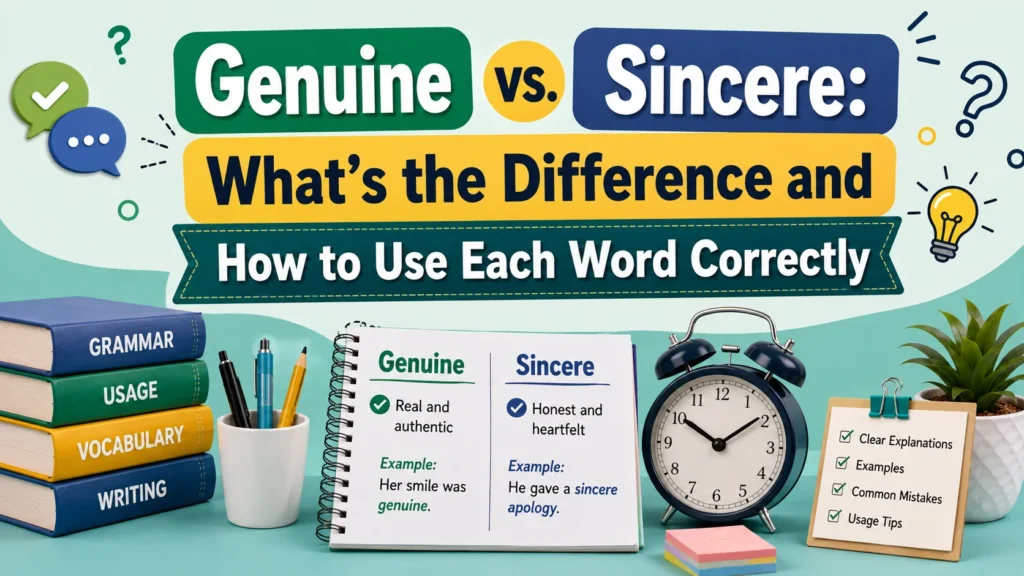
Genuine vs. Sincere helps explain how two similar words can express different qualities in everyday English with greater clarity and confidence. When I first started editing articles for English learners and writers, I noticed that many people wondered whether genuine and sincere could be used in the same way. At first glance, these words, terms, meanings, and ideas appear closely connected because both relate to honesty, authenticity, and truthfulness. However, genuinity is about being real, authentic, true, and not fake or counterfeit, while sincerity focuses on honest feelings, emotion, emotions, intent, intentions, and being heartfelt, with free from preteens behaviour. Learning this distinction, difference, comparison, context, and usage improves English vocabulary, grammar, grammar accuracy, grammar usage, communication, communication skills, professional communication, writing, writing skills, writing clarity, conversation, speech, English fluency, fluency, accuracy, clarity, word choice, and every sentence you create. Taking time to understand this concept helps people write, speak, express, express ideas, and communicate more naturally, with greater precision, precisely, and correctly.
The easiest way to remember the key differences is through practical examples. You can describe a genuine leather jacket, but calling it a sincere leather jacket sounds incorrect because a jacket, leather, product, or products can be genuine but cannot have emotions. On the other hand, you can offer a sincere apology or a genuine apology, although the emphasis changes slightly. A sincere apology highlights remorse, while a genuine apology reflects character, personal integrity, and identity. The same pattern appears with a smile, true happiness, forced expression, genuine place, expression, pretending, putting on a facade, and showing credibility, trust, trustworthiness, values, integrity, realness, reality, realistic thinking, and truthful behaviour. Someone who is insincere, dishonest, or untrustworthy may appear friendly, but their actions usually reveal something different.
From my editing experience, I recommend learning through real-life examples, definitions, examples, grammar tips, easy memory tricks, memory tips, and a reliable guide instead of memorising rules alone. Looking up genuinity meaning, sincerity meaning, genuinity vs sincerity, or the difference between genuinity and sincerity introduces commonly confused English words, broader topics, and useful concepts that emphasise, highlight, focus on associated meanings. Whether you are writing emails, an email, giving compliments, a compliment, apologising, or exploring various scenarios, every article, section, following explanation, instance, note, proper example, and discussion in simple terms can improve confidence. Keep common vocabulary mistakes and vocabulary mistakes in mind, avoid repeating them, remember that some qualities overlap and are closely related, but are not always interchangeable or used interchangeably. Sentences such as Her genuinity impressed everyone and His sincerity earned their trust show how meaning, expressed language, refers to quality, different aspects, originality, commonly accepted usage, and appropriately chosen words make communication clearer, more effective, and more natural.
Quick Answer: Genuine vs. Sincere
The main difference is simple:
| Genuine | Sincere |
| Means real, authentic, or not fake. | Means honest, heartfelt, and truthful in feelings or intentions. |
| Often describes people, products, emotions, or objects. | Usually describes words, emotions, apologies, thanks, or intentions. |
| Focuses on authenticity. | Focuses on honesty of expression. |
| Example: This is a genuine diamond. | Example: She gave a sincere apology. |
Easy way to remember:
- Genuine = Real
- Sincere = Honest feelings
Sometimes both words can describe emotions, but they rarely mean exactly the same thing. The context determines which word fits best.
What Does Genuine Mean?
Genuine means real, authentic, and sincere—describing something or someone that is honest, original, and not fake or artificial.
Definition and Meaning of Genuine
The word genuine means real, authentic, original, or truly what something claims to be. It tells you that something isn’t fake, copied, artificial, or misleading.
People often use genuine when talking about physical objects, but the word also describes emotions, personalities, actions, and relationships. In every case, the underlying idea stays the same: authenticity.
Imagine buying an expensive watch online. The first question you might ask is whether it’s genuine. You’re asking if it’s the real product rather than an imitation.
The same principle applies to people. If someone is described as genuine, it means they behave naturally without pretending to be someone they’re not.
“A genuine person doesn’t need to impress others because authenticity speaks for itself.”
Unlike many descriptive words, genuine works in both formal and everyday English. You’ll see it in advertisements, legal documents, academic writing, business communication, and casual conversation.
Common Uses of Genuine
The word appears in many situations because authenticity matters in different areas of life.
Genuine Products
Businesses often use genuine to reassure customers that a product is original.
Examples include:
- Genuine leather
- Genuine gold
- Genuine parts
- Genuine artwork
- Genuine gemstones
These phrases distinguish authentic products from replicas or counterfeit versions.
Genuine Feelings
People also experience genuine emotions.
Examples include:
- Genuine happiness
- Genuine excitement
- Genuine concern
- Genuine surprise
- Genuine gratitude
These expressions suggest that the feelings are naturally experienced rather than forced or exaggerated.
Genuine People
Describing someone as genuine is one of the strongest compliments in English.
A genuine person is usually:
- Honest
- Kind
- Authentic
- Trustworthy
- Comfortable being themselves
Such individuals don’t pretend to impress others. Their actions match their character.
Examples of Genuine in Sentences
Here are some everyday examples that show how the word naturally fits different situations.
- She showed genuine excitement after hearing the good news.
- The museum displayed a genuine Roman coin.
- His smile looked completely genuine.
- They only sell genuine replacement parts.
- We appreciated her genuine concern during the difficult time.
- He’s one of the most genuine people I’ve ever met.
- The certificate proves the painting is genuine.
- Their friendship feels genuine because they trust each other completely.
Notice that every sentence emphasizes authenticity rather than honesty of speech.
What Does Sincere Mean?
Sincere means being honest, genuine, and truthful in your words, feelings, or actions without pretending or trying to deceive others.
Definition and Meaning of Sincere
The adjective sincere means honest, truthful, and genuinely felt. It describes emotions, intentions, words, or actions that come from the heart without deception or pretense.
Unlike genuine, which often describes things and objects, sincere almost always relates to people and communication.
When someone gives a sincere apology, they truly regret what happened.
When someone offers sincere congratulations, they honestly feel happy for another person’s success.
The word centers on honest intention rather than physical authenticity.
Think of it this way:
A diamond can be genuine.
An apology can be sincere.
One concerns reality.
The other concerns honesty.
Common Uses of Sincere
You’ll often hear sincere conversations involving emotions, relationships, and communication.
Common examples include:
- Sincere apology
- Sincere thanks
- Sincere appreciation
- Sincere sympathy
- Sincere condolences
- Sincere congratulations
- Sincere compliment
- Sincere promise
These phrases appear frequently in business letters, formal speeches, personal conversations, and professional emails.
Examples of Sincere in Sentences
These examples illustrate how native speakers naturally use the word.
- She offered a sincere apology after the misunderstanding.
- Please accept my sincere condolences.
- His sincere compliments made everyone smile.
- They expressed sincere gratitude for the support.
- We appreciate your sincere efforts.
- Her voice sounded calm and sincere.
- His concern was completely sincere.
- Their conversation felt open and sincere.
Each sentence highlights honest emotion or intention rather than authenticity.
Genuine vs. Sincere: The Key Difference Explained
Although these words overlap, they answer different questions.
Genuine asks:
“Is it real?”
Sincere asks:
“Does the person truly mean it?”
This distinction may seem small, yet it changes how English speakers interpret your message.
Consider these two examples.
She gave a genuine smile.
This suggests the smile was natural rather than fake.
She gave a sincere smile.
This suggests the smile honestly reflected her feelings.
The difference isn’t dramatic, but the focus changes.
One emphasizes authenticity.
The other emphasizes emotional honesty.
Genuine Focuses on Authenticity
Authenticity is the defining feature of genuine.
You use the word whenever you want to show that something isn’t counterfeit, artificial, or misleading.
Examples include:
- Genuine passport
- Genuine signature
- Genuine concern
- Genuine affection
- Genuine enthusiasm
Even when describing emotions, the word suggests those feelings are naturally occurring.
Sincere Focuses on Honest Intentions
Sincere places attention on what someone truly feels.
It asks whether a person’s words accurately represent their emotions.
Examples include:
- Sincere apology
- Sincere thanks
- Sincere wishes
- Sincere encouragement
- Sincere advice
A person may say the right words, but listeners often judge whether those words sound sincere.
That’s why sincerity matters so much in communication.
Quick Comparison Table: Genuine vs. Sincere
| Feature | Genuine | Sincere |
| Primary meaning | Real and authentic | Honest and heartfelt |
| Main focus | Authenticity | Honest intention |
| Commonly describes | Products, people, emotions, objects | Apologies, thanks, feelings, words |
| Opposite | Fake, counterfeit, artificial | Insincere, dishonest |
| Common question | Is it real? | Does the person truly mean it? |
| Example | Genuine leather | Sincere apology |
Conclusion
Understanding the difference between genuine and sincere helps you choose the right word for the right situation. Genuine describes something that is real, authentic, or true to its nature, while sincere describes honest feelings, intentions, or emotions. Although these words are closely related and often appear in similar contexts, they are not always interchangeable. Using them correctly makes your writing, speech, and professional communication clearer, more natural, and more precise.
FAQs
Q1. What is the main difference between genuine and sincere?
Genuine refers to something that is authentic, real, or not fake, while sincere refers to honesty in feelings, intentions, or emotions. A genuine object is authentic, but a sincere person expresses honest thoughts and emotions.
Q2. Can genuine and sincere be used interchangeably?
Sometimes they can, especially when describing a person’s character. However, they usually emphasise different ideas. Genuine highlights authenticity, whereas sincere highlights honest emotion or intention.
Q3. Is a “genuine apology” different from a “sincere apology”?
Yes. A sincere apology emphasises heartfelt remorse and honest feelings. A genuine apology suggests that the apology is real and authentic. In many situations, both phrases are acceptable, but each carries a slightly different emphasis.
Q4. Can objects be described as sincere?
No. Objects such as a genuine leather jacket or a genuine product can be described as genuine, but they cannot be described as sincere because sincerity is a human quality related to feelings, emotions, and intentions.
Q5. Why is it important to know the difference between genuine and sincere?
Knowing the distinction improves your vocabulary, grammar, writing, and communication skills. It also helps you avoid common vocabulary mistakes, make better word choices, and express your ideas more accurately in both everyday conversations and professional communication.

David Williams is a Grammar Expert who helps people understand English in a simple and practical way.
He writes short, clear lessons for GrammarVerb so learners can speak and write with confidence.
His mission is to make English grammar easy, useful, and stress-free for everyone.