
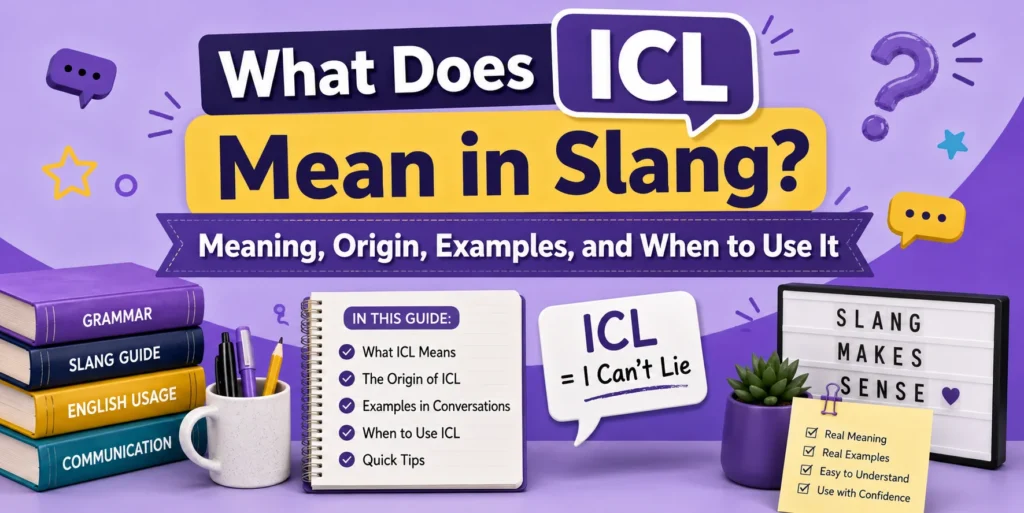
ICL Meaning is easy to understand once you know the context behind this popular acronym in texting and social media today. Most people use ICL to mean I Can’t Lie (or I Can’t Lie), while others may interpret it as I Care Less in a different context. This abbreviation, chat abbreviation, internet acronym, and online acronym appears in text messages, messages, online chats, group chat, group chats, casual chats, conversation, conversations, online conversations, digital conversations, and across Ticktock, Snap chat, Instagram, social platforms, and other online communities. From my experience, learning common internet slang, online slang, social media slang, chat slang, texting slang, and digital slang makes it much easier to understand a friend’s reply, comment, caption, social media comment, or social media posts because the expression usually sounds more genuine, honest, truthful, and authentic in everyday communication.
The definition, full form, acronym meaning, meaning, and different meanings of ICL depend on context clues, since multiple meanings can exist in different contexts. A good guide, complete guide, overview, breakdown, explanation, comparison, difference, reference, and practical insight improve understanding, learning, and knowledge for users, readers, young people, teens, young adults, and Gen Z. Although the term is most common in online communication, it can also appear in business, business documents, professional reports, technology, education, healthcare, medical information, medical brochures, ophthalmology, eye surgery, implantable col lamer lens, vision correction, sports, major league, and other fields. Paying attention to interpretation, contextual meaning, relevance, and natural language helps you recognise the correct usage every time.
In everyday digital communication, people often use ICL to share an honest opinion, express truth, sincerity, real feelings, or make a light confession before saying something important. You may notice it beside a picture, photo, outfit, compliment, reaction, or response, especially when a trend goes viral or becomes widely used. As online culture continues to evolve, new terms quickly gain traction, while others disappear just as quickly, making it helpful to stay updated and keep learning. Even if a phrase seems confusing at first glance, understanding its origin, message clarity, communication skills, and the context behind it will help you decode the meaning naturally instead of feeling out of the loop.
Quick Answer: What Does ICL Mean?
| Question | Answer |
| Meaning | I Can’t Lie |
| Common Use | Showing honesty before giving an opinion or admission |
| Tone | Casual, friendly, conversational |
| Used On | TikTok, Snapchat, Instagram, X, Discord, WhatsApp, text messages |
| Formal? | No |
| Alternative Phrases | Honestly, To be honest, NGL, Truthfully |
In short: ICL means “I Can’t Lie.” People use it to signal honesty before making a statement, expressing an opinion, or admitting something.
What Does ICL Mean?
ICL is an abbreviation with several meanings depending on the context. In everyday communication, it most commonly stands for “I Can’t Lie,” a casual phrase people use to introduce an honest opinion or confession.
The Primary Meaning of ICL: “I Can’t Lie”
The abbreviation ICL stands for “I Can’t Lie.” It’s a conversational expression that lets people know they’re about to share an honest thought.
Unlike formal phrases such as “In my opinion” or “Frankly speaking,” ICL sounds natural in casual conversations. That’s one reason it has become popular among younger internet users.
For example:
- ICL, that pizza was incredible.
- ICL, I forgot your birthday.
- ICL, you handled that situation really well.
In each example, ICL adds emphasis to the speaker’s sincerity.
What People Usually Mean When They Say ICL
Most people don’t use ICL to announce an important truth. Instead, they use it to soften opinions or make them sound more genuine.
Common situations include:
- Sharing honest opinions
- Complimenting someone
- Admitting mistakes
- Making funny confessions
- Agreeing with another person
Think of it as a conversation starter that says:
“Here’s what I really think.”
Why the Phrase Adds Emphasis
Without ICL:
That game was amazing.
With ICL:
ICL, that game was amazing.
The second version feels more personal because it tells readers the opinion is sincere rather than casual.
How Do You Use ICL in Conversations?
People naturally place ICL at the beginning of a sentence, although it sometimes appears in the middle.
Expressing Honest Opinions
People often use ICL before reviews or personal thoughts.
Examples:
- ICL, this restaurant deserves the hype.
- ICL, that ending surprised me.
- ICL, this update made the app much better.
Admitting Something Embarrassing
ICL also introduces honest confessions.
Examples:
- ICL, I forgot the meeting.
- ICL, I still watch cartoons.
- ICL, I laughed way too hard.
Agreeing With Someone
Sometimes ICL strengthens agreement.
Example:
Friend: That song is underrated.
You: ICL, you’re right.
Giving Personal Preferences
Examples include:
- ICL, winter is my favorite season.
- ICL, coffee tastes better without sugar.
- ICL, I’d rather stay home tonight.
Examples of ICL in Everyday Messages
Seeing ICL in context makes it much easier to understand.
Friends and Casual Chats
- ICL, you’ve improved a lot.
- ICL, I missed hanging out.
- ICL, that was hilarious.
Text Messages
Person A: Did you like the movie?
Person B: ICL, it was one of the best I’ve seen this year.
Social Media Captions
- ICL, this vacation was exactly what I needed.
- ICL, today’s sunset looked unreal.
- ICL, life feels good lately.
Gaming Conversations
- ICL, that boss fight wasn’t easy.
- ICL, your strategy actually worked.
Group Chats
- ICL, we should plan another trip.
- ICL, everyone looked great in those photos.
What Is the Origin of ICL?
The origin of ICL comes from internet and texting culture, where it is used as a shorthand for “I Can’t Lie.” It became popular on social media platforms like TikTok, Snapchat, and X (formerly Twitter) as a quick way to introduce an honest opinion or confession.
How the Abbreviation Developed
ICL grew from the longer phrase “I can’t lie.”
English speakers have used that phrase for decades. As texting became more common, people shortened familiar expressions to save time.
That’s how abbreviations like these became popular:
| Full Phrase | Short Form |
| I Can’t Lie | ICL |
| To Be Honest | TBH |
| Not Gonna Lie | NGL |
| For Real | FR |
Growth Through Texting Culture
Smartphones changed how people communicate.
Instead of typing complete sentences, users preferred quicker abbreviations. ICL naturally became part of that trend because it communicates honesty in just three letters.
Popularity on Social Media
ICL spread quickly through:
- TikTok comments
- Snapchat conversations
- Instagram captions
- Discord servers
- X (formerly Twitter)
- WhatsApp chats
Today, it’s recognized by millions of social media users worldwide.
Where Is ICL Most Commonly Used?
Different platforms use ICL in slightly different ways.
TikTok
Creators often begin comments with ICL before giving opinions about videos.
Example:
ICL, this deserves more views.
Snapchat
Friends use ICL during everyday conversations.
Example:
ICL, today was exhausting.
Users frequently include it in captions and replies.
Example:
ICL, this might be my favorite picture.
X (Formerly Twitter)
Short posts encourage abbreviations like ICL.
Example:
ICL, this season has been amazing.
Discord
Gamers often use it while discussing games or strategies.
Family and friends use ICL naturally in casual chats.
ICL in Texting vs. Spoken Conversation
In texting, ICL is commonly used as a quick abbreviation to save time and keep conversations short. In spoken conversation, however, people usually say the full phrase instead of the abbreviation, since abbreviations like ICL are rarely spoken aloud in everyday communication.
When People Type It
Typing ICL saves time.
Instead of writing:
I can’t lie…
People simply write:
ICL…
When People Actually Say “I Can’t Lie”
Most people don’t pronounce the letters I-C-L in conversation.
Instead, they usually say:
I can’t lie…
Speaking the full phrase sounds much more natural.
Differences in Tone and Impact
| Texting | Speaking |
| Uses ICL | Uses “I can’t lie” |
| Very casual | Slightly more expressive |
| Faster to type | More natural aloud |
ICL Meaning by Context
Context changes how ICL feels.
Positive Statements
- ICL, you’re talented.
- ICL, that cake tastes amazing.
Negative Opinions
- ICL, that movie disappointed me.
- ICL, the service was slow.
Confessions
- ICL, I forgot your message.
- ICL, I overslept today.
Humor and Sarcasm
Friends sometimes use ICL sarcastically.
Example:
ICL, that was definitely your best idea…
The tone tells listeners the speaker is joking.
Is ICL Always “I Can’t Lie”?
Usually, yes.
However, ICL can have other meanings in different industries.
| Meaning | Field |
| I Can’t Lie | Internet slang |
| Implantable Collamer Lens | Eye surgery |
| International Computers Limited | Technology history |
| Integrated Circuit Laboratory | Engineering |
When chatting online, I Can’t Lie is almost always the intended meaning.
Context makes the difference.
Similar Slang Terms You Should Know
Many abbreviations express honesty or emphasis.
NGL
Meaning: Not Gonna Lie
Example:
NGL, I expected more.
TBH
Meaning: To Be Honest
Example:
TBH, I agree.
FR
Meaning: For Real
Example:
FR, that’s impressive.
Lowkey
Used for opinions or feelings that aren’t expressed strongly.
Example:
Lowkey excited.
No Cap
Means someone is telling the truth.
Example:
That’s the best pizza ever, no cap.
ICL vs. NGL: What’s the Difference?
Although both expressions introduce honest opinions, they aren’t identical.
| Feature | ICL | NGL |
| Full Phrase | I Can’t Lie | Not Gonna Lie |
| Tone | Honest and conversational | Honest with slight emphasis |
| Popularity | Growing | Very common |
| Best Used For | Opinions and admissions | Opinions and surprises |
Which Sounds More Natural?
Both are common.
However:
- ICL feels slightly more conversational.
- NGL often introduces surprising opinions.
Examples:
- ICL, that restaurant exceeded my expectations.
- NGL, I didn’t expect it to be that good.
When Should You Use ICL?
ICL works best in relaxed conversations.
Use it when:
- You’re texting friends.
- You’re posting on social media.
- You’re chatting in gaming communities.
- You’re sharing personal opinions.
- You’re making casual recommendations.
Because it signals honesty, it often makes your message sound more genuine.
When You Should Avoid Using ICL
Despite its popularity, ICL doesn’t belong everywhere.
Avoid it in:
- Business emails
- Academic papers
- Job applications
- Professional reports
- Formal presentations
Instead, write:
- Honestly
- In my opinion
- Frankly
- To be honest
Those alternatives suit professional communication much better.
Is ICL Appropriate for Kids and Teens?
Yes.
Unlike many internet abbreviations, ICL is not offensive or inappropriate.
Parents generally don’t need to worry when children use it because it simply means “I Can’t Lie.”
Even so, parents should encourage children to understand the context of online slang rather than using abbreviations automatically.
Online Safety Reminder
While ICL itself is harmless, it’s still important for young users to:
- Think before posting.
- Avoid sharing personal information.
- Communicate respectfully.
- Recognize that slang changes over time.
Common Mistakes People Make With ICL
Many misunderstandings happen because people assume every abbreviation has only one meaning.
Here are the most common mistakes.
Using It in Formal Situations
ICL doesn’t belong in professional writing.
Misunderstanding Its Meaning
Some people confuse it with technical abbreviations used in medicine or engineering.
Context solves that problem.
Assuming Everyone Knows It
Older readers or people unfamiliar with internet slang may not recognize ICL.
When writing for a broad audience, spelling out “I can’t lie” may be clearer.
Conclusion
ICL Meaning is simple once you understand the context in which it appears. In most texting and social media conversations, it stands for I Can’t Lie and is used to introduce an honest opinion, feeling, or confession. Because ICL can have different meanings in other fields, paying attention to the context helps you choose the correct interpretation. Learning common internet abbreviations like ICL makes online communication clearer and helps you keep up with modern digital language.
FAQs
Q1. What does ICL mean in texting?
In texting, ICL most commonly means “I Can’t Lie.” People use it before sharing an honest opinion, feeling, or confession.
Q2. Is ICL used only on social media?
No. Although ICL is popular on Ticktock, Instagram, and Snap chat, it is also commonly used in text messages, group chats, online forums, and messaging apps.
Q3. Can ICL have more than one meaning?
Yes. While I Can’t Lie is the most common meaning in casual conversations, ICL can represent different terms in healthcare, business, and technology. The correct interpretation always depends on the context.
Q4. When should I use ICL in a conversation?
Use ICL when you want to introduce a truthful opinion, honest feeling, or personal confession in an informal conversation. It is best suited for texting, social media, and group chats rather than professional communication or formal communication.
Q5. Why is it useful to know the meaning of ICL?
Understanding ICL Meaning helps you follow online conversations, understand internet slang, avoid confusion, and communicate more naturally in today’s digital communication and social media culture.

I translate “complicated grammar” into simple, visual language that any person can learn fast. I believe English confidence is not about perfection — it’s about clarity and impact. Every guide I publish is designed to help you speak smarter, write sharper, and feel more powerful in English.