
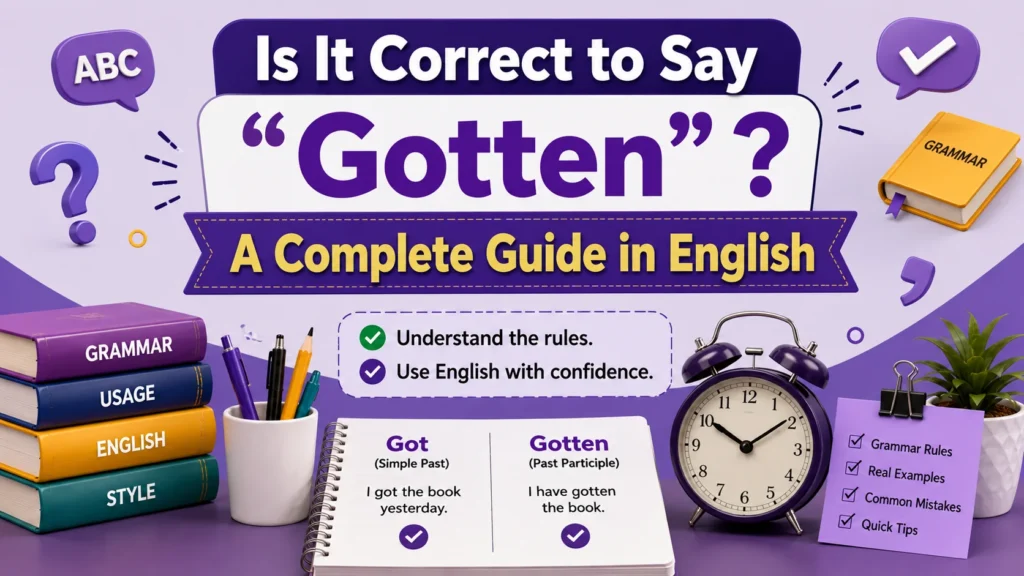
The is it correct to say gotten question is easy to answer because gotten is correct in American English and accepted by grammar.Many English learners, English speakers, native speakers, and learners wonder whether gotten is a real word or an outdated expression. From my editing experience, it is the standard past participle of the verb get, making it grammatically correct in standard English and modern English. In British English, got is usually preferred, so the right choice depends on your audience, context, and the varieties of English you are using. This guide and complete guide provide a clear explanation, strengthen grammar, improve grammar accuracy, reduce common confusion, avoid grammar mistakes, and build fluency, clarity, and better communication through proper usage, language usage, writing, speaking, conversation, and writing and conversation.
The English language has changed over time through evolution and has evolved across oceans, creating regional differences, regional variations, regional usage, and broader language variation. In the United States, you will often see gotten in newspapers, books, academic writing, business communication, and everyday communication, while British contexts generally prefer got. American contexts commonly use gotten for obtaining, receiving, or becoming better, such as getting a new book or improving at playing the piano, while possession or ownership, like having a new car, is often expressed with got. These examples, practical examples, sentences, rules, and differences make understanding much easier and help you choose, choose the form, choose correctly, apply, and apply correctly in different situations.
This section breaks down, highlights, and explains the subtle differences between formal English and informal English with a focus on accuracy, style, expression, phrase, wording, forms, form, and verb form. Whether you are speaking to everyday speakers, discussing ideas with linguists, or answering a question, these tips improve writing skills, speaking skills, and communication skills. The truth, fact, and key takeaway are that both got and gotten are acceptable in the right contexts, although correctness, preference, and grammatical basis depend on the audience. If you have ever wondered, joined the debate, heard different opinions, noticed puzzled looks, reached a grammatical crossroads, explored the layers behind this invention, or rarely hear one form, remember that common, commonly used, helps, improving, confusing, ongoing, generally, meanwhile, obtaining something, receiving something, improvement, improvement over time, confidence, confidently, past forms, past participle, happens, happening, incorrect, hello, world, and English all contribute to choosing the best word for each sentence
Is “Gotten” a Real Word?
Absolutely. Gotten is a legitimate English word with centuries of documented history. It is neither slang nor an error.
Many people mistakenly believe that gotten is a modern creation. In reality, it has existed for hundreds of years and appeared in English long before modern American English developed.
Today, dictionaries recognize gotten as the past participle of get, especially in American English.
Quick answer
| Question | Answer |
| Is “gotten” grammatically correct? | Yes |
| Is “gotten” used in American English? | Yes, very commonly |
| Is “gotten” common in British English? | No, British English usually prefers “got” |
| Is “gotten” acceptable in formal writing? | Yes, when appropriate for your audience and dialect |
Common misconception
Some writers avoid gotten because they think it sounds informal. That assumption isn’t accurate.
Consider these examples:
- The company has gotten approval from regulators.
- Researchers have gotten encouraging results from the latest study.
- She has gotten significantly better at public speaking.
All three sentences follow standard American English grammar.
Got vs. Gotten: What’s the Difference?
The confusion usually comes from the fact that both words originate from the same verb: get.
However, they don’t always perform the same grammatical role.
Basic distinction
- Got commonly serves as the simple past tense.
- Gotten commonly serves as the past participle in American English.
Here’s a simple comparison.
| Verb Form | Example |
| Base verb | get |
| Present | get / gets |
| Present participle | getting |
| Past tense | got |
| Past participle (American English) | gotten |
| Past participle (common British usage) | got |
Examples in context
Simple past:
- I got a promotion last year.
- She got home before midnight.
- We got several emails this morning.
Past participle:
- I have gotten much faster at typing.
- She has gotten permission to publish the report.
- They had gotten enough evidence before the trial began.
Notice how the helping verbs have, has, and had introduce the participle form.
Quick Comparison of Got and Gotten
The table below highlights the most important differences.
| Feature | Got | Gotten |
| Part of speech | Past tense of “get” | Past participle of “get” |
| Standard in American English | Yes | Yes |
| Standard in British English | Yes | Less common |
| Often follows “have” | Sometimes | Frequently |
| Common meaning | Received or obtained in the past | Acquired, become, or changed state |
Although the distinction seems technical, it becomes intuitive once you see repeated examples.
The Verb Forms of “Get”
Learning every form of the verb helps eliminate confusion.
| Form | Example |
| Base | get |
| Third-person singular | gets |
| Present participle | getting |
| Simple past | got |
| Past participle (US) | gotten |
Present tense
The present tense describes habits, routines, or current actions.
Examples:
- I get up at six every morning.
- She gets excellent customer reviews.
- They get fresh deliveries every Tuesday.
Present participle
The -ing form works in continuous tenses.
Examples:
- He is getting ready for work.
- We are getting closer to the deadline.
- They were getting nervous before the presentation.
Past tense
The simple past uses got.
Examples:
- I got your message yesterday.
- She got a new apartment last month.
- We got stuck in traffic.
Past participle
American English commonly uses gotten after helping verbs.
Examples:
- I have gotten stronger through regular exercise.
- She has gotten approval from the committee.
- They had gotten everything organized before guests arrived.
Why Does American English Use “Gotten”?
Many people assume Americans invented gotten, but history tells a different story.
An older English form
Centuries ago, speakers in England regularly used gotten as the past participle of get.
Later, language preferences shifted. British English gradually moved toward using got in many contexts, while North American English retained the older participle.
In other words:
- Britain simplified usage.
- America preserved an earlier form.
This explains why modern readers encounter sentences like:
- American English: “She has gotten much better.”
- British English: “She has got much better.”
Both constructions are correct within their respective dialects.
Language naturally evolves
English constantly changes over time.
Words disappear, spellings shift, and grammar evolves through actual usage rather than strict logic. The coexistence of got and gotten reflects that evolution.
It’s similar to other dialect differences such as:
| American English | British English |
| gotten | got |
| apartment | flat |
| truck | lorry |
| vacation | holiday |
| elevator | lift |
Neither version is inherently superior. The best choice depends on your audience.
When to Use “Got”
Although gotten receives plenty of attention, got remains extremely common.
Use “got” for the simple past
Examples:
- I got home late.
- She got excellent grades.
- We got the tickets online.
- They got the contract signed.
Use “have got” to express possession
In many varieties of English, have got functions similarly to have.
Examples:
- I have got two dogs.
- She’s got blue eyes.
- We’ve got enough supplies.
- They’ve got an important meeting tomorrow.
Here, I have got express possession rather than acquisition.
Everyday expressions with “got”
Common phrases include:
- got home
- got married
- got lucky
- got sick
- got lost
- got caught
- got involved
These expressions appear naturally in both speech and writing.
When to Use “Gotten”
The past participle gotten often emphasizes change, acquisition, or achievement.
Expressing acquisition
Examples:
- We have gotten permission to proceed.
- She has gotten several awards this year.
- The startup has gotten additional funding.
Showing change over time
Examples:
- The weather has gotten colder.
- His pronunciation has gotten clearer.
- Technology has gotten dramatically faster.
Describing completed development
Sometimes gotten highlights progress rather than possession.
Compare:
- She has got a driver’s license. (She possesses one.)
- She has gotten a driver’s license. (She recently obtained one.)
That subtle distinction often explains why American writers prefer gotten in contexts involving change or acquisition.
Side-by-Side Examples of Got and Gotten
Reading paired examples makes the difference easier to understand.
| Sentence | Why It Works |
| I got a raise last month. | Simple past action |
| I have gotten several raises over my career. | Past participle showing accumulated acquisition |
| She got better after resting. | Simple past event |
| She has gotten much better since surgery. | Ongoing improvement leading to the present |
| They got approval yesterday. | Completed past action |
| They have gotten approval from every department. | Present perfect emphasizing successful acquisition |
A useful memory aid is this:
If you’re using “have,” “has,” or “had” and you’re writing for an American audience, “gotten” is often the natural choice when referring to obtaining something or becoming something.
Conclusion
The answer to whether it is correct to say gotten is yes. Gotten is the correct past participle of get in American English, while British English usually prefers got in many of the same situations. Knowing the difference helps you avoid common grammar mistakes, improve your writing and speaking, and choose the right form for your audience and context. Once you understand when each form is appropriate, your English will sound more natural and accurate.
FAQs
Q1. Is gotten a real English word?
Yes. Gotten is a real and grammatically correct word. It is the standard past participle of get in American English.
Q2. Why do British speakers usually say got instead of gotten?
In British English, got is the preferred form in most situations. Although gotten was once used historically, it is now much less common in everyday British usage.
Q3. When should I use gotten?
Use gotten when writing or speaking in American English, especially to describe obtaining, receiving, or becoming something. For example, “She has gotten much better at tennis.”
Q4. Is it wrong to use gotten in British English?
Not always, but it may sound unusual to many British readers or listeners. If your audience is mainly British, got is usually the better choice.
Q5. How can I remember the difference between got and gotten?
A simple trick is to remember that American English commonly uses gotten, while British English generally prefers got. Think about your context and audience before choosing the form.

I translate “complicated grammar” into simple, visual language that any person can learn fast. I believe English confidence is not about perfection — it’s about clarity and impact. Every guide I publish is designed to help you speak smarter, write sharper, and feel more powerful in English.