
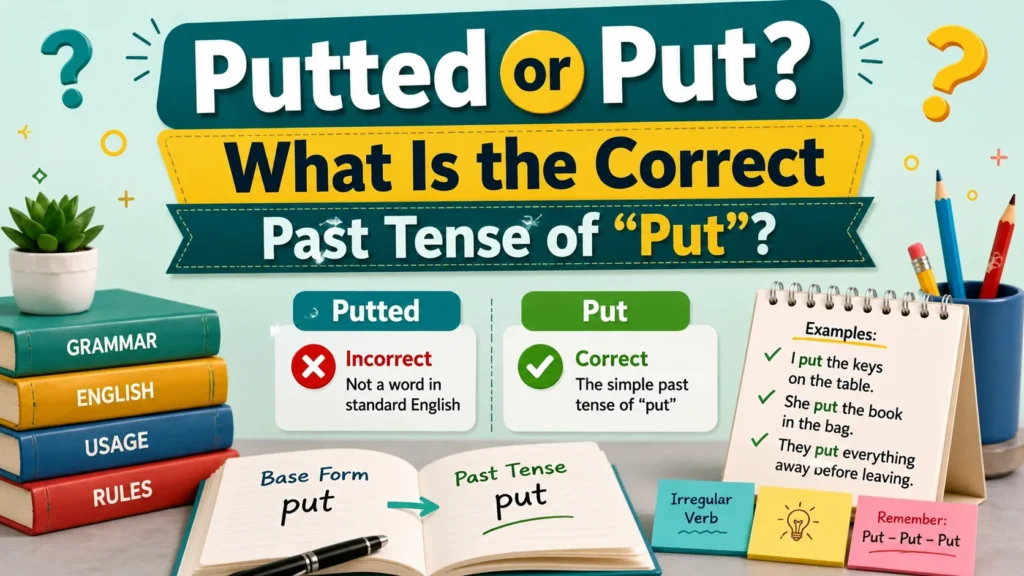
The Putted or Put question has a simple answer: put is always the correct form in English, while putted is only correct in golf.Many English learners, beginners, advanced learners, and native speakers face this common question because the verb to put is an irregular verb. Its base form, present, present tense, past, past tense, and past participle stay the same across all tenses, making the usage more consistent than many people expect. Although many learners try adding -ed by following conventional rules, this pattern does not follow normal tense formation because the verb behaves differently. This guide gives the short answer, removes confusion, prevents common confusion, mix-ups, mistakes, and other grammar mistakes, while helping you build confidence, become confident, improve clarity, and communicate in standard English through grammar, English grammar, grammar rules, simple rules, correct usage, and better communication.
From my editing experience, I often see writers who have placed a book on a table, moved groceries, silenced a phone before a meeting, trusted a manager, or left a backpack on a chair yesterday but still hesitate over the verb. These examples, real-life examples, real-world usage, and usage examples explain the difference between the wrong form and the correct form in writing, speaking, conversation, conversations, daily writing, daily speaking, everyday communication, and everyday conversations. They make your language, vocabulary, writing skills, speaking skills, and communication skills feel more natural, more natural, reliable, precise, clear, and straightforward while strengthening what you already know.
This journey of understanding helps you remember through memory tricks, simple tricks, tricks, idiomatic expressions, and practical practice until remembering becomes easy. You can master other irregular verbs by comparing each form and noticing that this one stays constant and does not change form even when something happened or is happening. One important exception appears in golf, where putted comes from the verb putt, meaning to gently strike a golf ball toward the hole, so it works in that niche situation. This article and exploration encourage you to consider this deceptively simple truth instead of treating it like a curve ball. If the topic has ever popped up, popped up, made you paused, wondering, or caused hesitation, you can now use it without hesitation in every audience and English setting.
Putted vs. Put: Which One Is Correct?
For everyday English, the answer couldn’t be simpler:
The correct past tense of “put” is “put.”
The spelling never changes when you move from present to past.
Compare these examples:
| Sentence | Correct? | Explanation |
| I put the dishes in the sink. | ✅ | Present tense |
| I put the dishes in the sink yesterday. | ✅ | Past tense |
| I have put the dishes in the sink. | ✅ | Past participle |
| I putted the dishes in the sink yesterday. | ❌ | Incorrect for the verb “put” |
This unusual pattern often surprises learners because English usually signals the past tense by changing the verb or adding -ed.
The simple rule
If put means to place, position, move, or set something somewhere, the past tense is always put.
Examples:
- I put the keys on the counter this morning.
- She put the children to bed early.
- We put our luggage in the trunk.
- They put extra effort into the project.
Notice that the spelling remains unchanged in every example.
Why “putted” sounds tempting
English contains thousands of regular verbs that form the past tense with -ed.
For example:
| Base Verb | Past Tense |
| Call | Called |
| Watch | Watched |
| Help | Helped |
| Smile | Smiled |
| Paint | Painted |
It’s understandable that learners assume put → putted should follow the same pattern.
It simply doesn’t.
What Is the Past Tense of “Put”?
The verb put belongs to a small but important group of irregular verbs whose forms remain identical across multiple tenses.
Here’s the complete conjugation.
| Verb Form | Correct Form |
| Base form | put |
| Third-person singular | puts |
| Present participle | putting |
| Simple past | put |
| Past participle | put |
This table alone answers many grammar questions.
Present tense
Use put or puts to describe current habits or repeated actions.
Examples:
- I put my wallet in the same drawer every night.
- She puts fresh flowers on the table every weekend.
- The chef puts herbs into the soup before serving.
Past tense
When describing completed actions, continue using put.
Examples:
- Yesterday I put all the files into storage.
- He put the bike in the garage after work.
- They put new curtains in every room.
No letters change. No -ed appears.
Past participle
Perfect tenses also use put.
Examples:
- I have put the books back on the shelf.
- She has put significant time into research.
- They had put the issue behind them before the meeting.
The helping verb changes while put stays exactly the same.
Present participle
The only form that changes noticeably is putting.
Examples:
- We are putting together a proposal.
- He is putting away groceries.
- They were putting decorations around the room.
Verb Forms of “Put” at a Glance
Many learners appreciate seeing every form together.
| Tense | Example Sentence |
| Present | I put my phone on the desk every evening. |
| Present continuous | I am putting my phone on silent. |
| Simple past | I put my phone on silent yesterday. |
| Past continuous | I was putting the files away when you arrived. |
| Present perfect | I have put everything in order. |
| Past perfect | She had put the letters in the mailbox before lunch. |
| Future | I will put the packages outside tomorrow. |
| Future perfect | By noon, we will have put all the chairs away. |
A useful memory trick is this:
If the verb means “to place something,” chances are the answer is simply “put.”
Why Is “Put” an Irregular Verb?
English inherited vocabulary from several language families over many centuries. As those languages blended, some verbs kept older conjugation patterns instead of adopting the newer -ed rule.
The verb put belongs to that older tradition.
Regular versus irregular verbs
A regular verb follows a predictable pattern.
| Regular Verb | Past Tense |
| Open | Opened |
| Cook | Cooked |
| Clean | Cleaned |
| Laugh | Laughed |
An irregular verb doesn’t follow that formula.
| Irregular Verb | Past Tense |
| Go | Went |
| See | Saw |
| Cut | Cut |
| Hit | Hit |
| Put | Put |
Some irregular verbs change dramatically. Others, like put, don’t change at all.
Why English keeps these exceptions
Languages evolve through actual usage rather than perfect logic.
Frequently used words often resist change because speakers become accustomed to them. Over centuries, common verbs preserve older forms while less common words adapt to newer grammatical patterns.
That’s why modern English still includes unusual pairs such as:
- go → went
- bring → brought
- buy → bought
- come → came
- put → put
Although these patterns require memorization, daily exposure soon makes them feel natural.
Why Do People Say “Putted”?
The mistake usually comes from applying a sensible rule to an exceptional verb.
Children learning English often say things like:
- “I goed home.”
- “She bringed cookies.”
- “He putted the toys away.”
These forms reveal that the speaker understands the basic -ed pattern but hasn’t yet learned the irregular exception.
Common reasons for confusion
- English contains many regular verbs ending in -ed.
- Learners expect consistency across grammar rules.
- Spell-check tools sometimes miss context-based verb errors.
- Spoken English doesn’t always highlight subtle grammatical distinctions.
A practical example
Imagine someone writing:
“Last night I putted the dishes in the dishwasher.”
The intended meaning is placing dishes, so the correct sentence becomes:
“Last night I put the dishes in the dishwasher.”
That one-word correction makes the sentence grammatically accurate.
The Important Exception: “Putted” in Golf
Here’s where things become interesting.
Putted isn’t always wrong.
It’s perfectly correct when it comes from the verb putt, a golf term meaning to strike the ball gently on the green toward the hole.
For example:
- The golfer putted from eight feet and made the shot.
- She putted confidently throughout the final round.
- He putted better than anyone else in his group.
Notice that these examples have nothing to do with placing objects somewhere.
Put vs. putt
The extra t changes everything.
| Word | Meaning | Past Tense |
| Put | To place or position | Put |
| Putt | To hit a golf ball gently | Putted |
This distinction explains why some people mistakenly believe putted should work in ordinary writing. They have seen it used correctly in sports coverage, but they apply it to the wrong verb.
Memory trick: If you’re talking about furniture, books, bags, or keys, use put. If you’re talking about a golf green and a golf club, putted may be exactly right.
Conclusion
Choosing between put and putted becomes easy once you know the rule. In standard English, put is the correct form for the present tense, past tense, and past participle of the verb to put. The only common exception is in golf, where putted comes from the verb putt. Remembering this simple difference will improve your grammar, make your writing and speaking sound more natural, and help you communicate with confidence.
FAQs
Q1. Is putted ever correct?
Yes. Putted is correct only when talking about golf, where it is the past tense of the verb putt. For the verb put, the correct past tense is always put.
Q2. What is the past tense of put?
The past tense of put is put. The verb does not change its form, making it an irregular verb.
Q3. Why do people mistakenly write putted?
Many learners expect every verb to follow the -ed pattern. Since verbs like walk become walked, they assume put becomes putted, but that rule does not apply here.
Q4. Is put also the past participle?
Yes. Put is the base form, past tense, and past participle. You can say, “I put the keys on the desk,” and “I have put the keys on the desk.”
Q5. How can I remember the correct form?
A simple trick is to remember that put never changes. Whenever you are unsure, use put for the present, past, and past participle, unless you are talking about golf, where putted is correct.

Sophia Moore is a Writing Coach who teaches English through real-life context, not boring theory.She develops smart mini-lessons for GrammarVerb so learners can write naturally and with precision.Her goal is to make English style clear, modern, and effective for every level.