
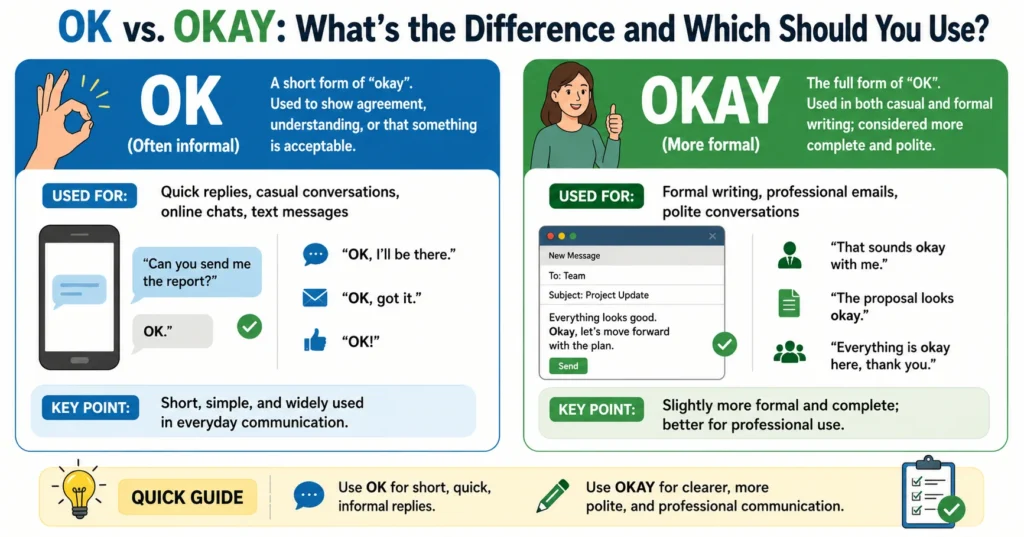
The OK vs. Okay debate is simple because OK, okay, O.K., and Ok all express the same meaning in English with different styles.Whether you write a text message, email, or business proposal, your choice should match the audience, context, and writing style. Most English speakers and native speakers use these forms interchangeably in conversation, casual conversation, spoken English, written English, messaging, and written communication. From my editing experience, keeping consistency, clarity, and readability matters more than picking one spelling over another. Good punctuation, capitalisation, and proper grammar help every sentence look more polished, intentional, and appropriate, whether the tone is formal or informal.
A trusted dictionary or several dictionaries recognise every accepted variant, making each alternative spelling part of standard English and modern English. Learning the history, word history, etymology, abbreviation, abbreviation style, phrase, and expression improves your language learning, language usage, language conventions, and English grammar. A reliable style guide, editorial style, presentation style, and usage guide also help when working on publication, novel, business writing, formal writing, email writing, or professional communication across different communication contexts and language contexts.
This guide encourages you to discover, compare, and apply practical examples, usage examples, and writing examples to strengthen writing skills, communication skills, and vocabulary. Looking at the differences, similarities, comparison, expression choice, word choice, and spelling preference makes everyday communication easier. Whether you are sending a reply or response to a friend, creating friendly communication, or preparing spoken communication, remember that acceptance, agreement, approval, and acknowledgement all share the same confirmation of correct usage. If you have ever paused to decide what to type, these common variations, forms, used day-to-day by millions, let you communicate immediately with confidence
OK vs. Okay at a Glance
Before diving deeper, here’s a quick comparison.
| Feature | OK | Okay |
| Meaning | Acceptance, agreement, or adequacy | Acceptance, agreement, or adequacy |
| Pronunciation | /oh-kay/ | /oh-kay/ |
| Grammatically correct | Yes | Yes |
| Dictionary accepted | Yes | Yes |
| Common in emails | Yes | Yes |
| Common in texting | Very common | Common |
| Often preferred for brevity | Yes | No |
| Fully spelled-out form | No | Yes |
Key takeaway
If you’re wondering which version to use, the answer is straightforward:
- Use “OK” when you want brevity or a concise visual style.
- Use “okay” when you prefer a fully spelled-out word that blends naturally into prose.
- Stay consistent throughout the same document.
Are OK and Okay the Same Word?
From a practical standpoint, yes. They express the same idea and function in the same ways. Whether you’re giving permission, confirming plans, or describing something as acceptable, both spellings communicate the same message.
Consider these examples:
- “The report looks OK to me.”
- “The report looks okay to me.”
Neither sentence changes meaning. Most readers won’t notice a difference beyond stylistic preference.
Shared meaning and function
You can use either spelling to:
- Show agreement.
- Confirm understanding.
- Express permission.
- Describe something as acceptable.
- Ask about someone’s condition.
- Signal that everything is satisfactory.
For example:
| Situation | Example |
| Agreement | “OK, let’s start the meeting.” |
| Permission | “It’s okay to leave early today.” |
| Checking welfare | “Are you OK after the accident?” |
| Moderate quality | “The movie was okay, but not amazing.” |
| Confirmation | “OK, I’ll send the files tonight.” |
The flexibility of the word partly explains why it has become one of the world’s most recognizable expressions.
Why dictionaries recognize both spellings
Modern dictionaries include OK and okay because decades of widespread usage established both forms as standard English. Lexicographers generally describe language as people actually use it rather than inventing rules in isolation.
As usage evolved, writers adopted the spelled-out version while retaining the original abbreviated appearance. Eventually, both became accepted entries.
Perception can vary slightly
Although the definitions match, readers sometimes perceive subtle stylistic differences.
- OK often feels quick, direct, and efficient.
- Okay may appear slightly smoother in narrative writing because it looks like an ordinary word instead of an abbreviation.
These impressions stem from convention rather than grammar. Neither spelling carries greater authority.
Quick tip: If your publication or employer has a style guide, follow it consistently instead of switching between forms.
The Origin of OK and How Okay Developed
The history of OK surprises many people. Contrary to popular myths, it didn’t begin as an ancient foreign expression or secret code. Instead, its roots trace back to an amusing language trend in nineteenth-century America.
The “Oll Korrect” phenomenon
During the late 1830s, newspapers occasionally played with humorous misspellings and abbreviations. One joke intentionally misspelled “all correct” as “oll korrect”, then shortened it to “OK.”
What started as wordplay caught readers’ attention. The abbreviation spread quickly through newspapers and everyday communication.
It’s a reminder that even playful language can leave a lasting mark.
Newspapers fueled rapid adoption
Journalists and editors repeated the abbreviation until audiences became familiar with it. Because newspapers reached large populations, the expression traveled far beyond its original circle.
Within a relatively short time, people used OK in business correspondence, personal letters, and public notices.
How “okay” emerged later
As the abbreviation gained popularity, writers naturally began spelling it out as “okay.” The longer form fit comfortably into books, articles, and dialogue where abbreviations sometimes disrupted reading flow.
Today, neither spelling can claim exclusive legitimacy. Both belong to standard English.
Common myths about the origin
Several alternative theories circulate online, but historical evidence supports the nineteenth-century abbreviation explanation far more strongly.
Popular myths include claims that OK originated:
- From military terminology.
- From telegraph operators.
- From Greek expressions.
- From Native American languages.
- From shipping labels meaning “zero killed.”
These stories remain interesting folklore, yet historians generally point to the humorous “oll korrect” abbreviation as the strongest documented origin.
Which Spelling Came First: OK or Okay?
Many readers assume okay came first because it looks like a complete word. Surprisingly, history suggests the opposite.
A brief timeline
| Period | Development |
| 1830s | “OK” appears as an abbreviation for “oll korrect.” |
| Mid-1800s | Newspapers and public figures popularize “OK.” |
| Later years | Writers increasingly use the spelled-out form “okay.” |
| Modern era | Both spellings coexist and are widely accepted. |
That sequence explains why OK still appears in all capital letters. Its roots lie in abbreviation rather than conventional word formation.
OK, Okay, O.K., and Ok Explained
You may encounter several visual forms of the same expression. Although they usually mean the same thing, frequency and style differ.
OK
This remains the most recognizable version worldwide. Businesses, software interfaces, and everyday communication frequently use it because it’s compact and immediately understood.
Examples:
- “Click OK to continue.”
- “Everything is OK now.”
Okay
The spelled-out version often appears in articles, fiction, essays, and conversational prose.
Examples:
- “She smiled and said everything was okay.”
- “It’s okay if you need more time.”
O.K.
Older publications sometimes inserted periods between the letters because editors treated the expression as a traditional abbreviation.
Today, that style appears far less often. Most modern publishers simply write OK.
Ok
You might also see Ok, especially in casual digital conversations.
While readers understand it without difficulty, many editors prefer OK or okay for polished writing because those forms align more closely with established conventions.
Is OK More Informal Than Okay?
Not necessarily.
Both spellings work in formal and informal settings. The surrounding context matters more than the letters themselves.
For instance, a project manager might write:
“The proposal is OK for client review.”
Another manager could write:
“The proposal is okay for client review.”
Neither sentence sounds unprofessional.
Where differences emerge is in tone. OK can feel brisk and efficient while okay often blends more naturally into flowing paragraphs.
Case study: The same message in different contexts
| Context | Preferred Example |
| Text message | “OK, see you soon!” |
| Business email | “The revised budget looks OK.” |
| Blog article | “The solution works okay for most users.” |
| Novel dialogue | “Okay, let’s go,” she whispered. |
| Mobile app button | “OK” |
The audience rarely objects to either version. Consistency creates a stronger impression than the specific spelling you choose.
Conclusion
OK and okay are both correct, and choosing between them depends on your writing style, audience, and context. Whether you are writing a quick email, a text message, or a formal document, staying consistent is more important than picking one spelling over the other. Once you understand their shared meaning and common usage, you can write with greater confidence and make your communication look clear and professional.
FAQs
Q1. Is OK more correct than okay?
No. Both OK and okay are correct spellings. Most dictionaries accept both, and the best choice depends on your preferred style and context.
Q2. Can I use okay in professional writing?
Yes. Okay is widely accepted in business writing, emails, and other professional communication. Just keep your spelling consistent throughout the document.
Q3. Why do some people write O.K. instead of OK?
O.K. is an older style that uses periods. Today, OK is much more common, although O.K. is still considered acceptable in some publications and style guides.
Q4. Should I use OK or okay in text messages?
Either works well. In text messages and casual conversations, people often choose the spelling they personally prefer since both have the same meaning.
Q5. Do OK and okay have different meanings?
No. OK and okay express the same idea of agreement, acceptance, or approval. The difference is mainly one of spelling and presentation, not meaning.

Sophia Moore is a Writing Coach who teaches English through real-life context, not boring theory.She develops smart mini-lessons for GrammarVerb so learners can write naturally and with precision.Her goal is to make English style clear, modern, and effective for every level.