Learning Further vs. Furthermore improves word choice, clarity, and English writing, making every sentence more natural and precise. Many writers struggle with word choice because further and furthermore appear interchangeable, yet each word has a different function, functions, role, and usage. The right choice depends on the context, sentence structure, and the message you want to share. This comprehensive guide explains the distinction so you can understand how both words improve sentences, keep ideas clear, precise, and professional, and strengthen grammar, precision, and communication skills. From my own experience, I have seen many writer friends improve their work simply by paying closer attention to these small differences in English writing.
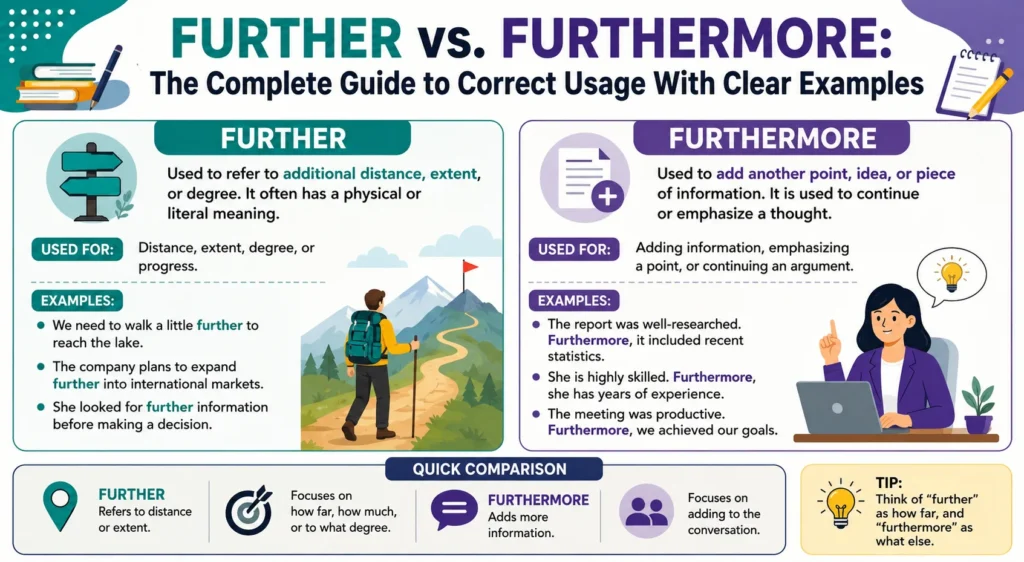
In English, further usually describes distance, physical distance, extent, or a metaphorical extension, while furthermore is a transitional adverb used to add additional information, extra points, or a new idea. It often means in addition or moreover, making it perfect for formal writing, a research paper, business report, or professional emails. You may discuss an argument, explain a plan, mention a budget, or write “can’t walk any further” when talking about movement. The reader follows the flow more smoothly when the correct word is chosen. Paying attention to semantic precision, linguistic nuance, rhetorical clarity, rhetorical articulation, phrasing, textual coherence, and meaning reduces misinterpretation, strengthens expression, creates coherent sentences, and increases the overall impact of your ideas in both formal and casual text.
From regular practice, observing, and understanding examples, I have learned that steady improvement comes with time. Whether you are a student, content writer, or professional, this guide helps you apply the rules in essays, an essay, drafts, an email, emails, a blog post, blog articles, a paper, reports, and everyday texts. If you feel stuck, take a pause instead of pondering too long. Careful thinking, focus, and knowledge improve accuracy, sophistication, and effective writing. Mastering this skill through regular practice helps you convey ideas naturally, enhance overall writing, overall communication, and strengthen communication without sounding awkward or incorrect. Over time, your vocabulary, style, style tips, grammar proficiency, composition, clarity and flow, rhetorical effect, and thoughtful approach will shape stronger messages, helping every reader grasp your meaning with greater confidence.
Further vs. Furthermore: What’s the Difference?
The simplest way to remember the difference is this:
- Further usually means additional, more, or to a greater extent. It can function as an adjective, adverb, or verb.
- Furthermore is a transitional adverb that introduces another supporting point or adds information to strengthen what came before.
Here’s a quick comparison.
| Feature | Further | Furthermore |
| Primary meaning | Additional, more, beyond | In addition, moreover |
| Part of speech | Adjective, adverb, verb | Conjunctive adverb |
| Common purpose | Describe extent or add information | Connect ideas and strengthen arguments |
| Everyday use | Very common | More formal |
| Can act as a verb? | Yes | No |
Think of further as a flexible multitool. Think of furthermore as a bridge that links one idea to the next.
A Quick Memory Trick
If you could replace the word with “in addition” or “moreover,” then furthermore is often the better choice.
If you mean extra, more, beyond, or continue, then further usually fits naturally.
What Does “Further” Mean?
The word further serves several grammatical functions, which explains why it appears so often in English.
Further as an Adjective
As an adjective, further means additional or extra.
Examples
- We need further information before making a decision.
- The company announced further changes to its hiring policy.
- No further action is required.
In these examples, you could replace further with additional without changing the meaning.
Further as an Adverb
As an adverb, further means to a greater degree or to a greater extent.
Examples
- The discussion moved further into technical details.
- She investigated the issue further before responding.
- The project cannot proceed further without approval.
Notice that the word describes how an action continues or extends.
Further as a Verb
Many people forget that further can also function as a verb. In that form, it means to advance, promote, or help develop something.
Examples
- The scholarship aims to further scientific research.
- Education helps further economic growth.
- The investment will further innovation across the industry.
This usage appears frequently in business, nonprofit organizations, and academic writing.
What Does “Furthermore” Mean?
Unlike further, furthermore has one primary function. It acts as a conjunctive adverb that introduces an additional supporting idea.
You can often replace it with:
- Moreover
- In addition
- Additionally
- What’s more
Definition and Function
Writers use furthermore to connect related thoughts logically.
For example:
The software reduces processing time. Furthermore, it lowers operating costs.
The second sentence strengthens the first rather than changing the topic.
Typical Sentence Placement
You’ll usually find furthermore at the beginning of a sentence.
Examples:
- Furthermore, customer satisfaction increased after the update.
- The proposal reduces expenses. Furthermore, it improves efficiency.
- The policy benefits employees. Furthermore, managers support the initiative.
While punctuation styles vary, many editors place a comma after furthermore when it begins a sentence.
Further vs. Furthermore: Side-by-Side Comparison
The following table highlights the most important differences.
| Aspect | Further | Furthermore |
| Main idea | Additional or beyond | Adds another supporting point |
| Flexibility | Highly flexible | Primarily transitional |
| Tone | Neutral | Formal |
| Spoken English | Very common | Less common |
| Academic writing | Frequently used | Frequently used |
| Business communication | Common | Common in reports and proposals |
| Can modify nouns | Yes | No |
| Can function as a verb | Yes | Never |
If you only remember one thing, remember this: further has multiple jobs while furthermore mainly connects ideas.
When to Use “Further”
Understanding context matters more than memorizing rules.
Use “Further” for Additional Information
Sometimes you simply need to indicate that something extra exists.
Examples:
- Please provide further documentation.
- We have no further questions.
- The article offers further analysis later.
Use “Further” for Degree or Extent
The word also works when discussing progress or continuation.
Examples:
- The road continues further north.
- The committee examined the matter further.
- Scientists studied the evidence further before publishing.
Use “Further” in Professional Writing
Business communication often relies on concise wording.
Examples:
- Contact us for further assistance.
- Further review is necessary.
- The board requested further clarification.
Because it sounds direct without becoming overly formal, many organizations prefer it.
When to Use “Furthermore”
Choose furthermore when you want to strengthen an existing point rather than introduce an unrelated idea.
Strengthening an Argument
Suppose you’re writing an essay about renewable energy.
You might write:
Solar power reduces emissions. Furthermore, it decreases long-term operating costs.
The second statement supports the first instead of replacing it.
Building Logical Flow
Academic papers often depend on orderly transitions.
Example:
The experiment produced reliable results. Furthermore, independent researchers replicated the findings successfully.
The transition tells readers that another reason follows.
Improving Persuasive Writing
Marketing copy, legal arguments, and policy documents frequently employ furthermore to reinforce claims.
For instance:
The program improves employee retention. Furthermore, it lowers recruitment expenses.
Can “Further” and “Furthermore” Be Interchangeable?
Sometimes yes. Often no.
Consider these examples.
Natural
- We need further evidence.
- We need additional evidence.
Replacing further with furthermore would create an ungrammatical sentence.
Natural
- The proposal saves money. Furthermore, it improves productivity.
Replacing furthermore with further sounds awkward because the sentence requires a transitional connector.
Borderline Cases
Occasionally both words appear acceptable in broader contexts, especially when rewriting entire sentences. However, they rarely substitute for each other word for word.
The safest strategy is to identify each word’s grammatical role before choosing.
Common Mistakes and How to Avoid Them
Many writers repeat the same errors.
Mistake: Using “Furthermore” to Mean “Additional”
Incorrect:
We require furthermore information.
Correct:
We require further information.
Mistake: Treating “Further” Only as an Adverb
Some learners overlook its adjective and verb forms.
Correct examples:
- Further investigation is needed.
- The grant will further research.
- Please discuss the matter further.
Mistake: Overusing “Furthermore”
Adding furthermore before every supporting sentence quickly sounds repetitive.
Instead, alternate with:
- In addition
- Moreover
- Also
- Besides
- What’s more
- Equally important
Mistake: Forgetting Tone
In casual conversation, furthermore may sound stiff.
Instead of saying:
Furthermore, I’m hungry.
Most people simply say:
Also, I’m hungry.
Further vs. Farther: Don’t Mix Them Up
Many grammar discussions confuse further with farther.
Here’s an easy distinction.
| Word | Traditional Use |
| Farther | Physical distance |
| Further | Figurative distance or additional information |
Examples:
- We drove farther than expected.
- We need further discussion.
Modern English often accepts further for physical distance as well, especially in British usage. Many American style guides still recommend reserving farther for measurable distance.
Examples of “Further” in Real Sentences
The fastest way to master usage is through examples.
Everyday Conversation
- Can you explain that a little further?
- We have no further plans tonight.
- Let’s investigate further before deciding.
Workplace
- Management requested further documentation.
- The audit requires further review.
- The company hopes to further employee development.
Education
- Students should conduct further research.
- The professor encouraged further reading.
- The grant will further medical studies.
News Style
- Officials announced further restrictions.
- Authorities released further details.
- Analysts expect further market growth.
Examples of “Furthermore” in Real Sentences
The word works best when connecting ideas logically.
Essays
The novel explores identity. Furthermore, it challenges traditional social norms.
Reports
Revenue increased by 12%. Furthermore, operating expenses declined.
Research Papers
The sample size exceeded expectations. Furthermore, the methodology minimized bias.
Business Proposals
The software shortens processing times. Furthermore, it improves data security.
Case Study: Editing a Student Essay
Original paragraph:
Online education offers flexibility. Further, students save commuting time. Furthermore, many courses cost less. Further, digital tools improve collaboration.
Edited version:
Online education offers flexibility. Furthermore, students save commuting time. Many courses also cost less. In addition, digital tools improve collaboration.
The revised paragraph varies transitions naturally and avoids repetition.
Mini Exercise: Test Your Understanding
Choose the correct word.
Question 1
We need _____ evidence before reaching a conclusion.
Answer: Further
Question 2
The proposal reduces waste. _____, it cuts production costs.
Answer: Furthermore
Question 3
The donation will _____ cancer research.
Answer: Further
Question 4
Please investigate the matter _____.
Answer: Further
Question 5
The new policy boosts efficiency. _____, employee satisfaction improved.
Answer: Furthermore
Useful Alternatives to “Further”
Using the same word repeatedly weakens writing. These alternatives add variety.
| Alternative | Best Use |
| Additional | Formal documents |
| Extra | Everyday language |
| More | General writing |
| Continued | Ongoing actions |
| Beyond | Extent or limit |
| Supplemental | Technical writing |
Examples
- We need additional evidence.
- The report includes supplemental charts.
- No more revisions are necessary.
Useful Alternatives to “Furthermore”
These connectors help maintain a natural rhythm.
| Alternative | Typical Tone |
| Moreover | Formal |
| In addition | Neutral |
| Additionally | Formal |
| What’s more | Conversational |
| Besides | Informal |
| Also | Universal |
Example:
Sales increased significantly. Moreover, customer retention reached record levels.
Style Tips for Better Writing
Even experienced writers misuse transition words. These practical habits will improve clarity.
Match Your Audience
A legal brief welcomes formal connectors.
A text message usually doesn’t.
Choose language that fits your readers rather than impresses them.
Don’t Force Transitions
Not every paragraph needs furthermore or moreover.
Sometimes a direct sentence creates stronger momentum.
Prefer Clarity Over Complexity
Simple wording often communicates ideas more effectively.
Instead of stacking multiple transitions, let the logic of your argument guide the reader naturally.
Read Your Draft Aloud
Awkward transitions become obvious when spoken.
If furthermore sounds unnatural in conversation, another connector may work better.
Conclusion
Understanding the difference between further and furthermore helps you write with greater clarity, precision, and confidence. Although these words look similar, they serve different purposes in English writing. Further often extends an idea, distance, or discussion, while furthermore introduces an additional supporting point. By practising their correct usage and paying attention to context, you can create more professional, natural, and effective sentences in essays, emails, reports, and everyday communication.
FAQs
Q1. What is the difference between further and furthermore?
Further is commonly used to describe additional distance, extent, or discussion, while furthermore is a transitional adverb that adds another point or supporting idea in a sentence.
Q2. Can further and furthermore be used interchangeably?
Not always. Although they are related, further and furthermore have different functions. Using the correct word improves clarity and keeps your writing accurate.
Q3. Is furthermore more formal than further?
Yes. Furthermore is generally more common in formal writing, such as academic papers, business reports, and professional documents, while further works well in both formal and everyday contexts.
Q4. How can I remember when to use further?
Use further when talking about additional distance, progress, discussion, or extent. If you are simply adding another supporting point, furthermore is usually the better choice.
Q5. How can I improve my use of further and furthermore?
Read quality English content, practice writing every day, review examples, and pay attention to context. Over time, choosing between further and furthermore will become natural, making your communication clearer and more effective.

Sarah Johnson is a Language Teacher who explains English rules in simple everyday examples.She creates practical lessons for GrammarVerb so learners can improve their writing and communication skills. Her purpose is to make English learning clear, enjoyable, and easy to use in real life.