
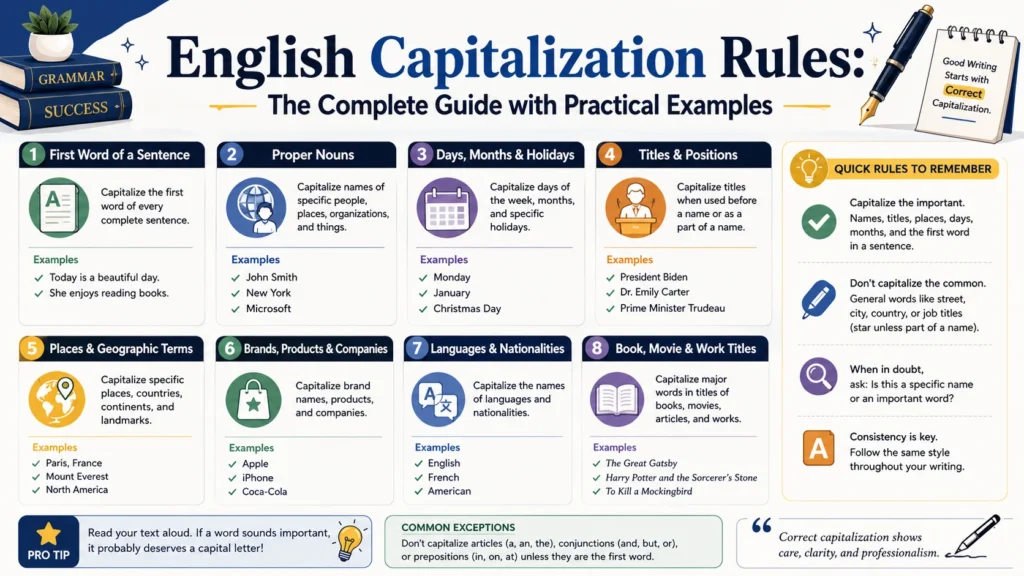
Using English Capitalization Rules correctly makes every sentence clearer, stronger, easier to read, and more professional every day.Many writers believe capitalization only means adding capital letters, but it is really about knowing when to capitalize the right word. Correct writing begins with the first word of a sentence, and the right choice can change meanings, show the importance of titles, names, and places, and make your work look polished. From my experience, mastering these basic rules is a small effort with a big impact. A single letter can help a person avoid mistakes and present ideas with confidence. Building a strong understanding through clear examples is the key to writing better English, and learning together makes the process easier.
The heart of English capitalization rules is recognising proper nouns and other specific words that need attention. This includes people, places, things, cities, countries, brands, and personal names. Titles before names, such as Doctor Smith and Queen Elizabeth, always begin with a capital letter. Days of the week, months of the year, and holidays also start with capitals, while seasons usually do not unless they are part of a title or name. The pronoun I is always capitalized, no matter where it appears. In a book, movie, song, or other creative works, most words are capitalized, but short prepositions and articles are not unless they come before the first word. This approach includes another useful reminder that every title, name, and letter deserves careful attention.
Correct capitalization helps readers understand every message faster, avoids unnecessary confusion, and shows attention to detail. Whether you are drafting an email, publishing a blog post, preparing an academic paper, or posting on social media, these capitalization rules improve readability and credibility. Many learners struggle with questions about mo, job titles, or directions, but the good news is that simple patterns make them easier to remember. This comprehensive guide explains every important point with simple explanations, practical comparison tables, and editing tips you can apply right away. Lastly, if you follow these patterns, you will spot mistakes, improve your English, and your writing naturally improves. Whether you are a beginner or an experienced writer, last success comes from steady learning, using handy methods, recognising every proper noun, specific people, specific places, and specific things, while remembering starts, other exceptions, every mark of capitalization, and the complete lineup of English capitalization rules.
What Is Capitalization in English?
Capitalization means writing the first letter of a word as an uppercase letter when grammar or convention requires it. English uses capital letters to signal the beginning of sentences and to identify specific names, official titles, and certain other words.
Compare these examples:
| Incorrect | Correct |
| i visited paris last summer. | I visited Paris last summer. |
| my teacher assigned the book on monday. | My teacher assigned the book on Monday. |
| they speak english at home. | They speak English at home. |
Notice how capitalization instantly makes the sentences easier to read. Without it, proper nouns blend into common nouns and the text appears careless.
Why Correct Capitalization Matters
Following English capitalization rules offers several benefits:
- Improves clarity by distinguishing specific names from general terms.
- Creates a professional impression in business and academic writing.
- Supports consistency across websites, reports, and publications.
- Helps readers scan information more efficiently.
- Reduces ambiguity when multiple meanings are possible.
Think of capitalization as road signs on a highway. You can still travel without them, yet they make the journey smoother and prevent unnecessary mistakes.
Quick Tip: When proofreading, scan only for capital letters during one editing pass. Separating this task from grammar checks often catches errors you would otherwise miss.
The Basic Rules of English Capitalization
Although English contains a few exceptions, most capitalization follows a handful of dependable rules.
Capitalize the First Word of Every Sentence
Every complete sentence begins with a capital letter.
Correct examples:
- The meeting starts at noon.
- After dinner, we watched a documentary.
- Please close the window before leaving.
Even if the sentence starts with a number written as words, the first word receives a capital letter.
- Twenty people volunteered.
- One solution worked perfectly.
Capitalize the Pronoun “I”
English treats the pronoun I as a special case. It is always capitalized, regardless of where it appears.
| Incorrect | Correct |
| when i arrived, the show had started. | When I arrived, the show had started. |
| my sister and i baked cookies. | My sister and I baked cookies. |
| if i can help, i will. | If I can help, I will. |
This rule has no common exceptions in standard written English.
Capitalize the First Word in Direct Quotations
When a quotation forms a complete sentence, capitalize its opening word.
- Maria said, “Please bring your notebook.”
- The coach shouted, “Keep moving!”
- Dad asked, “Have you finished your homework?”
However, don’t capitalize a quoted fragment that continues another sentence.
- She described the movie as “surprisingly funny and emotionally honest.”
Capitalize the First Word After a Colon When It Introduces a Complete Sentence
Some style guides recommend capitalizing after a colon if what follows is a complete sentence or a formal statement.
Example:
- The conclusion became obvious: Everyone needed additional training.
When the colon introduces only a list or phrase, lowercase is usually appropriate.
Example:
- You need three items: paper, tape, and scissors.
When to Capitalize Proper Nouns
One of the most important English capitalization rules involves proper nouns. A proper noun names a unique person, place, organization, event, or thing. Unlike common nouns, proper nouns almost always begin with capital letters.
Names of People
Always capitalize personal names.
Examples:
- Emma finished the report.
- David called this morning.
- Sophia volunteered at the shelter.
Titles become part of the name when they immediately precede it.
- President Lincoln delivered the address.
- Professor Chen explained the experiment.
When the title stands alone or follows the name in a general sense, lowercase is often correct.
- The president addressed the nation.
- Alicia became the company’s chief executive officer.
Geographic Locations
Capitalize official geographic names.
| Capitalized | Example |
| Continents | Africa, Europe |
| Countries | Canada, Brazil |
| Cities | Chicago, Sydney |
| Rivers | Nile River, Colorado River |
| Mountains | Mount Everest |
| Oceans | Pacific Ocean |
By contrast, generic references remain lowercase.
- several rivers
- many mountains
- a beautiful valley
Countries, Nationalities, and Languages
These words always take capital letters because they derive from proper nouns.
- American
- Japanese
- Mexican
- Arabic
- Spanish
- French
Examples in sentences:
- She studies French every weekend.
- They ordered traditional Japanese cuisine.
- He holds Canadian citizenship.
Organizations, Institutions, and Companies
Official names receive capitalization.
Examples include:
- Green Valley High School
- World Health Organization
- Bright Future Foundation
- Silver Oak Consulting
Generic descriptions do not.
- the local hospital
- several universities
- many nonprofit organizations
Historical Events and Named Eras
Capitalize formally recognized events and periods.
- World War II
- Renaissance
- Industrial Revolution
- Great Depression
Generic references stay lowercase.
- ancient civilizations
- economic downturns
- civil conflicts
Religions, Religious Texts, and Deities
Standard English capitalizes:
- Christianity
- Islam
- Judaism
- Bible
- Quran
- Torah
- God (when used as a proper name)
Examples:
- They studied passages from the Bible.
- The museum displayed artifacts from Ancient Egypt, but discussions about religion remained broad and descriptive.
Capitalizing Days, Months, Holidays, and Historical Periods
Dates often cause confusion because English differs from many other languages.
Days and Months
Always capitalize:
- Monday
- Tuesday
- January
- April
- November
Examples:
- Our meeting is on Thursday.
- School begins in September.
Holidays
Holiday names also require capitals.
- Thanksgiving
- New Year’s Day
- Memorial Day
- Independence Day
- Halloween
Example:
- We decorate the house every Halloween.
Historical Periods
Recognized eras receive capitalization.
- Middle Ages
- Victorian Era
- Stone Age
- Bronze Age
Why Seasons Usually Stay Lowercase
Unlike months and days, the seasons are generally lowercase unless they appear in an official title or begin a sentence.
| Incorrect | Correct |
| I love Autumn. | I love autumn. |
| We traveled in Spring. | We traveled in spring. |
| Autumn brings colorful leaves. | Autumn brings colorful leaves. |
Remember this simple pattern:
- Monday → capitalize.
- October → capitalize.
- Autumn → lowercase unless grammar requires otherwise.
Quick Reference Table
| Category | Capitalize? | Example |
| First word of a sentence | Yes | Today is sunny. |
| Pronoun “I” | Yes | I agree. |
| Person’s name | Yes | Olivia |
| City or country | Yes | Tokyo, Italy |
| Language | Yes | German |
| Month | Yes | June |
| Day of the week | Yes | Friday |
| Season | Usually no | autumn |
| Common noun | No | teacher |
| Generic direction | Usually no | drive north |
Mini Editing Exercise
Correct the capitalization mistakes below before checking the answers.
- my brother moved to california in march.
- i studied spanish on monday.
- we visited the pacific ocean during summer.
- professor williams recommended the book.
- they celebrated thanksgiving with relatives.
Answers:
- My brother moved to California in March.
- I studied Spanish on Monday.
- We visited the Pacific Ocean during summer.
- Professor Williams recommended the book.
- They celebrated Thanksgiving with relatives.
Mastering these foundational rules makes every other capitalization decision much easier. Once you recognize the difference between proper nouns and common nouns, many common writing errors disappear on their own.
Conclusion
Learning english-capitalization-rules is one of the easiest ways to improve your writing. Using capital letters in the right places makes your sentences easier to read, helps readers understand your message, and gives your work a more professional appearance. By remembering the basic capitalization rules and practising with real examples, you can avoid common mistakes and write with greater confidence in every situation.
FAQs
Q1. What are English capitalization rules?
English capitalization rules explain when to use capital letters in writing. They cover the first word of a sentence, proper nouns, titles, days, months, holidays, and other special words that require capitalization.
Q2. Do you always capitalize proper nouns?
Yes. Proper nouns, including people, places, cities, countries, brands, and specific names, should always begin with a capital letter.
Q3. Are seasons capitalized in English?
Usually, seasons are written in lowercase. However, they are capitalized when they are part of a title or an official name.
Q4. Should job titles always be capitalized?
Job titles are capitalized when they appear before a person’s name, such as Doctor Smith or Queen Elizabeth. Otherwise, they are generally written in lowercase.
Q5. How can I improve my use of capitalization rules?
Read regularly, practice writing, review your sentences, and use editing tools to check your work. Over time, following English capitalization rules will become a natural part of your writing process.

David Williams is a Grammar Expert who helps people understand English in a simple and practical way.
He writes short, clear lessons for GrammarVerb so learners can speak and write with confidence.
His mission is to make English grammar easy, useful, and stress-free for everyone.