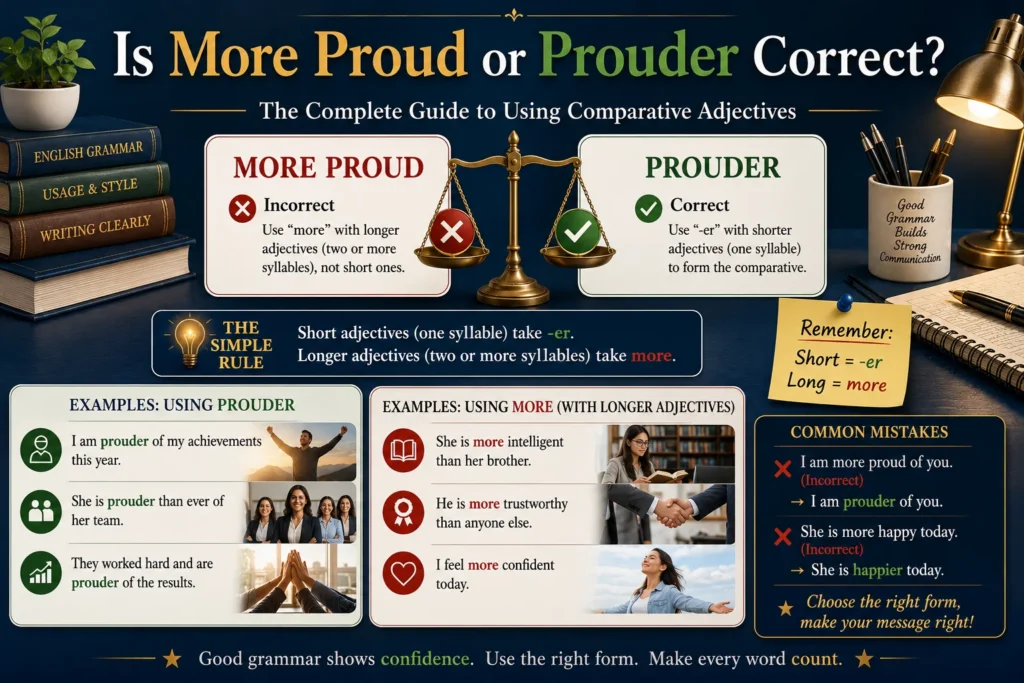
The More Proud or Prouder question often confuses learners, yet the right choice becomes clear once you understand grammar, comparison, and context.When I began teaching English learners, I often saw the same debate about more proud and prouder. At first, both forms seem acceptable, but English grammar follows a grammar rule for comparing adjectives. The comparative adjective usually takes the adjective ending -er, making prouder the preferred comparative form. Although more proud is also grammatically correct in certain contexts, more prouder is incorrect because it breaks English rules for comparative usage. This complete guide, complete breakdown, cheat sheet, and short answer provide useful examples that settle the debate. Whether you are a student, writer, editor, teacher, speaker, native speaker, or ESL learner learning English, you can compare every comparison form through the right comparison structure, comparison in English, and comparison between two things.
In my experience, success comes from understanding correctness, contextual meaning, contextual usage, formal context, informal context, and writing context, not just memorising rules. A formal report, report writing, speech writing, formal writing, heartfelt speech, text message, or texting conversation may require a different writing style, expression style, phrase comparison, or sentence structure based on the audience and audience expectation. Skilled English speakers focus on word choice, choice of words, meaning, meaning and feeling, emotion, feeling pride, tone, rhythm of language, clear communication, natural communication, and sincere communication. That is why both correct forms are both grammatically correct, yet not always interchangeable. The best choice depends on grammar structure, depends on correctness, and depends on context, while grammar flexibility, structure, and structure and soul improve language expression, English expression, and real usage.
I remember treating this topic like a challenging puzzle, walking through a maze, crossing crossroads, and trying to navigate through every grammatical puzzle before I finally figured out the answer. With practice, learning English became an exciting journey toward language mastery, true mastery, confidence, art, beauty, and soul. As you learn, learn exactly, and understand when to use each form, your automatic choice becomes natural, and you can use confidently in real life. Imagine climbing a steep hill, following a path, opening doors at the crossroads of grammar, and reaching a higher degree of pride than before. You may say, “I couldn’t be prouder of my son,” or “I am more proud of my achievements this year compared to last year or someone else.” Both options work best in different situations and help keep your communication simple, clear, and honest until the right form feels natural and effortless.
What Is the Comparative Form of Proud?
Before comparing prouder vs more proud, it helps to understand how comparative adjectives work.
A comparative adjective shows that one person, thing, or situation possesses more of a quality than another.
Consider these examples:
| Positive Adjective | Comparative Form |
| Tall | Taller |
| Fast | Faster |
| Small | Smaller |
| Proud | Prouder / More Proud |
The purpose of a comparative adjective is simple. It allows us to compare two things.
For example:
- Sarah is taller than Emma.
- This car is faster than that one.
- James is prouder of his achievement than he was last year.
English generally forms comparatives in one of two ways:
Adding “-er”
Many short adjectives add -er.
Examples include:
- Strong → Stronger
- Small → Smaller
- Kind → Kinder
- Proud → Prouder
Using “More”
Many longer adjectives use more.
Examples include:
- Beautiful → More beautiful
- Important → More important
- Difficult → More difficult
The confusion with proud occurs because both patterns appear in modern English.
Understanding Comparative Adjectives in English
Comparative adjectives play a major role in communication. Every day, people compare experiences, achievements, emotions, and relationships.
Without comparatives, conversations would become awkward.
Imagine saying:
“My current job is good. My previous job is good.”
The listener still doesn’t know which one you prefer.
Comparatives solve this problem:
“My current job is better than my previous job.”
The same principle applies to emotional adjectives such as proud.
You might compare:
- Your current confidence with your past confidence.
- One accomplishment with another.
- How proud one person feels compared to someone else.
This is why understanding the comparative form of proud matters.
Where “Proud” Fits in English Grammar
The word proud is an adjective.
It describes a feeling of satisfaction, achievement, honor, or self-respect.
Examples include:
- She feels proud of her work.
- They are proud of their community.
- We are proud of our team’s success.
Because proud is a one-syllable adjective, traditional grammar rules naturally support the form prouder.
However, English is not always rigid.
Language evolves through actual usage. Over time, speakers began using both prouder and more proud, making both acceptable in modern English.
That flexibility explains why dictionaries and grammar authorities recognize both forms today.
Is Prouder Correct?
Yes. Prouder is completely correct.
In fact, many grammar teachers consider it the traditional comparative form of proud.
The formation follows a familiar pattern:
- Proud → Prouder
- Loud → Louder
- Bright → Brighter
- Smart → Smarter
From a purely grammatical perspective, prouder fits the standard rule for short adjectives.
Why Native Speakers Often Prefer Prouder
Many native speakers choose prouder because it sounds natural and conversational.
It also creates a stronger emotional impact.
Consider these examples:
- I am prouder of you today than ever before.
- She felt prouder after completing the marathon.
- They became prouder of their heritage over time.
The word feels direct and powerful.
That’s one reason why it appears frequently in speeches, family conversations, and personal writing.
Comparative Adjectives: The Role of Prouder in Grammar
The word prouder serves as the standard comparative form within traditional English grammar.
Its primary purpose is to express an increased degree of pride.
For example:
| Base Statement | Comparative Statement |
| I am proud. | I am prouder now. |
| She is proud. | She is prouder today. |
| They are proud. | They are prouder than before. |
Notice how the comparison becomes more specific.
The comparative form adds depth and context.
Instead of simply describing pride, it measures the increase in pride.
That subtle distinction makes communication more precise.
Examples in Context: Using Prouder in Sentences
Seeing grammar in action often makes the rule easier to understand.
Here are examples from different situations.
Family Achievements
- I couldn’t be prouder of my daughter for graduating college.
- His parents were prouder than ever after his promotion.
- She felt prouder watching her son receive an award.
Workplace Success
- The team became prouder after breaking company records.
- Employees were prouder of the organization following the charity event.
- He felt prouder of his work after receiving positive feedback.
Education
- Students were prouder of their projects after presenting them.
- She became prouder of her academic progress each semester.
Personal Growth
- I am prouder of my consistency than my talent.
- She was prouder of overcoming obstacles than winning the competition.
These examples demonstrate why prouder remains extremely popular in everyday English.
The Emotional Weight Behind “Couldn’t Be Prouder”
One of the most common expressions in English is:
“I couldn’t be prouder.”
This phrase appears in:
- Graduation speeches
- Sports interviews
- Family celebrations
- Award ceremonies
- Social media posts
Why is it so popular?
Because it conveys maximum pride.
The speaker suggests they have reached the highest possible level of pride.
For example:
“Watching my daughter become a doctor, I couldn’t be prouder.”
The phrase carries emotional power because it feels personal, sincere, and heartfelt.
Many people prefer prouder over more proud in this expression because it sounds smoother and more natural.
Is More Proud Correct?
Yes. More proud is also grammatically correct.
This surprises many learners because they assume every one-syllable adjective must use the -er ending.
English rarely operates with absolute rules.
Certain adjectives allow two acceptable comparative forms.
Proud belongs to that category.
You may encounter more proud in:
- Formal writing
- Academic discussions
- News articles
- Professional speeches
- Literary works
While some speakers prefer prouder, many writers choose more proud because it creates a slightly different rhythm and emphasis.
Why More Proud Is Grammatically Acceptable
Modern grammar authorities recognize that language is shaped by usage.
Over centuries, English speakers have used both forms often enough that both became accepted.
Many dictionaries list:
- Proud
- Prouder
- More proud
as valid constructions.
This flexibility exists because proud occupies a middle ground.
Although it is short enough to take -er, it also sounds natural with more.
The result is a rare situation where writers have options.
Situations Where Writers Prefer More Proud
Although both forms are correct, some contexts make more proud feel slightly better.
Formal Writing
Formal documents often favor smoother, more measured language.
Example:
The organization became more proud of its commitment to sustainability.
Academic Writing
Scholarly writing sometimes prefers more proud because it sounds less conversational.
Example:
Participants reported feeling more proud after completing the program.
Public Speaking
Speakers occasionally choose more proud to emphasize the emotion.
Example:
I have never been more proud to represent this community.
Literary Writing
Authors often select words based on rhythm rather than grammar alone.
Sometimes more proud simply fits the sentence better.
Examples Using More Proud
Here are several natural examples.
- She was more proud of her effort than her final score.
- The coach felt more proud of the team’s discipline than its victory.
- Citizens became more proud of their city after the restoration project.
- I have never been more proud to serve this organization.
- They were more proud of the journey than the outcome.
Notice something important.
None of these examples sound strange.
That is exactly why both forms continue to coexist in modern English.
Prouder vs More Proud: Which Should You Use?
Now comes the question most people actually want answered.
If both “prouder” and “more proud” are correct, which one should you choose?
The answer depends on your audience, purpose, and writing style.
In many situations, either option works perfectly. However, subtle differences exist.
Prouder vs More Proud Comparison
| Feature | Prouder | More Proud |
| Grammatically Correct | Yes | Yes |
| Traditional Comparative Form | Yes | No |
| Common in Everyday Speech | Very Common | Common |
| Common in Formal Writing | Sometimes | Frequently |
| Emotional Impact | Strong | Moderate to Strong |
| Natural Conversation | Excellent | Good |
| Academic Writing | Less Common | More Common |
| Popular Expressions | Very Common | Less Common |
Looking at the table, one thing becomes clear.
Prouder dominates casual conversation, while more proud often appears in formal or carefully crafted writing.
Neither choice is wrong.
The best choice is the one that sounds natural in the sentence.
Differences in Tone and Style
Although the meaning remains the same, the tone can change slightly.
How Prouder Sounds
The word prouder feels:
- Direct
- Personal
- Emotional
- Conversational
- Natural
Example:
I am prouder of you today than I have ever been.
This sentence feels warm and personal.
How More Proud Sounds
The phrase more proud often feels:
- Formal
- Deliberate
- Reflective
- Measured
Example:
I have never been more proud to serve this community.
This version sounds polished and speech-like.
Neither carries a different definition. The distinction comes from style rather than grammar.
Which Form Sounds More Natural?
For most native speakers, prouder usually sounds more natural in everyday conversation.
Consider these examples:
Natural Conversation
- I’m prouder of myself than I was last year.
- She’s prouder than ever.
- We’re prouder of our team today.
Now compare:
- I’m more proud of myself than I was last year.
- She’s more proud than ever.
- We’re more proud of our team today.
The second set remains correct. However, many speakers instinctively prefer the first set.
That preference explains why prouder appears frequently in spoken English.
What Do Major Grammar Authorities Say?
One reason this debate continues is that people expect grammar authorities to choose a single winner.
In reality, most modern grammar references accept both forms.
The consensus is straightforward:
Both “prouder” and “more proud” are correct English.
The disagreement usually involves style rather than correctness.
Many modern dictionaries list prouder as the standard comparative form while acknowledging that more proud appears regularly in educated writing and speech.
This is not unusual.
English contains many words that allow more than one acceptable structure.
Guidance From Modern Dictionaries
Most dictionaries recognize prouder as the primary comparative form because it follows traditional adjective rules.
However, dictionaries also acknowledge widespread use of more proud.
This reflects an important reality about English.
Language does not always follow mathematical formulas.
Instead, usage shapes acceptance.
When millions of speakers consistently use a form correctly and naturally, grammar authorities often recognize it.
That is exactly what happened with more proud.
What Style Guides Recommend
Editorial style guides generally focus on clarity and readability.
Many editors prefer:
- Prouder for natural writing
- More proud when it improves rhythm or emphasis
For example:
Preferred
I couldn’t be prouder of our achievements.
Also Acceptable
I could not be more proud of our achievements.
Notice something interesting.
The second sentence appears frequently in speeches because it creates emphasis.
The first sentence appears more often in everyday communication.
Both are excellent English.
Why “More Prouder” Is Incorrect
While both prouder and more proud are correct, one form is definitely wrong:
More Prouder
This construction creates a grammatical error known as a double comparative.
A double comparative occurs when a speaker applies two comparative markers to the same adjective.
For example:
| Incorrect | Correct |
| More prouder | Prouder |
| More better | Better |
| More faster | Faster |
| More stronger | Stronger |
| More smarter | Smarter |
The adjective already contains a comparative ending.
Adding more creates an unnecessary duplication.
Think of it as putting two accelerator pedals in the same car.
One already does the job.
Understanding Double Comparatives
Double comparatives have existed for centuries.
In fact, older forms of English occasionally used them.
One famous example appears in Shakespeare:
“More better.”
Modern English, however, treats these forms as incorrect.
Current grammar standards require writers to choose one comparative structure.
You can either:
- Add -er
- Use more
You cannot use both together.
Examples of Incorrect Double Comparatives
Here are some common mistakes.
Incorrect
- She is more prouder today.
- He became more stronger.
- This solution is more better.
- The athlete is more faster now.
Correct
- She is prouder today.
- He became stronger.
- This solution is better.
- The athlete is faster now.
A quick proofreading check can help eliminate these errors.
Whenever you see both more and -er, examine the sentence carefully.
Correct Alternatives to More Prouder
Instead of writing:
I am more prouder than before.
Write:
I am prouder than before.
Or:
I am more proud than before.
Either correction works.
The key is choosing one comparative form.
Why Both Forms Exist in English
Many learners wonder why English allows both prouder and more proud.
The answer lies in language evolution.
English developed from multiple linguistic influences over centuries.
As a result, some adjectives gained flexible comparative forms.
Language often favors efficiency.
Yet it also values rhythm, expression, and emphasis.
Because speakers found both forms useful, both survived.
The Evolution of Comparative Adjectives
Old English relied heavily on adjective endings.
Writers commonly formed comparatives using suffixes such as -er.
Over time, English adopted alternative comparison structures.
The word more became increasingly common.
This shift gave speakers additional flexibility.
Eventually, some adjectives could comfortably use either system.
Proud became one of them.
When English Allows Two Comparative Forms
Proud is not alone.
Several adjectives occasionally appear with multiple comparative constructions.
Examples include:
| Adjective | Comparative Options |
| Proud | Prouder / More Proud |
| Pleasant | Pleasanter / More Pleasant |
| Common | Commoner / More Common |
| Polite | Politer / More Polite |
| Quiet | Quieter / More Quiet |
In practice, one form usually becomes more popular.
However, both remain acceptable.
This demonstrates how English often balances rules with real-world usage.
Real Examples From Everyday English
One of the best ways to understand grammar is to observe how people actually speak and write.
Let’s examine common situations.
Family Celebrations
Parents frequently say:
- I couldn’t be prouder of my daughter.
- We’ve never been prouder of our son.
These phrases appear in graduation announcements, social media posts, and family speeches.
Workplace Recognition
Managers often write:
- We are more proud than ever of our employees.
- The company is proud of its accomplishments.
- The leadership team is even prouder of its workforce this year.
Sports
Athletes and coaches frequently use comparative pride.
Examples include:
- I am prouder of our effort than our victory.
- The coach couldn’t be prouder of the team.
- Fans are more proud of the team’s resilience than its record.
Community Events
Public officials often prefer:
I have never been more proud to represent this city.
This phrasing sounds formal and ceremonial.
That explains its popularity in speeches.
Case Study: Graduation Speech Language
Imagine two graduation speeches.
Version One
I couldn’t be prouder of every graduate sitting before me today.
Version Two
I could not be more proud of every graduate sitting before me today.
Both sentences are correct.
Both communicate the same meaning.
The difference lies in tone.
The first feels personal and emotional.
The second feels formal and dramatic.
This illustrates why writers sometimes choose one form over the other.
Conclusion
Choosing between more proud and prouder becomes much easier once you understand the grammar rule, context, and tone behind each expression. While prouder is the more common comparative form, more proud is also grammatically correct in the right situation. The key is to focus on natural usage, your audience, and the purpose of your writing or speech. With regular practice, you will make the right word choice automatically and communicate with greater confidence and clarity.
FAQs
Q1. Which is correct: more proud or prouder?
Both are grammatically correct. However, prouder is usually the preferred comparative form, while more proud is often chosen for emphasis or a particular style.
Q2. Is more prouder ever correct?
No. More prouder is incorrect because it uses two comparative markers together. Use either prouder or more proud, not both.
Q3. Why do native speakers use both more proud and prouder?
Both expressions are accepted in English, but the best choice depends on context, tone, and the natural flow of the sentence.
Q4. Can I use more proud in formal writing?
Yes. More proud can appear in formal writing, reports, and speeches when it fits the style and sounds natural in the sentence.
Q5. How can I remember when to use prouder?
A simple tip is to use prouder as your first choice for everyday comparisons. If more proud sounds smoother or better matches the meaning and emotion you want to express, it is also an acceptable option.

Sophia Moore is a Writing Coach who teaches English through real-life context, not boring theory.She develops smart mini-lessons for GrammarVerb so learners can write naturally and with precision.Her goal is to make English style clear, modern, and effective for every level.