
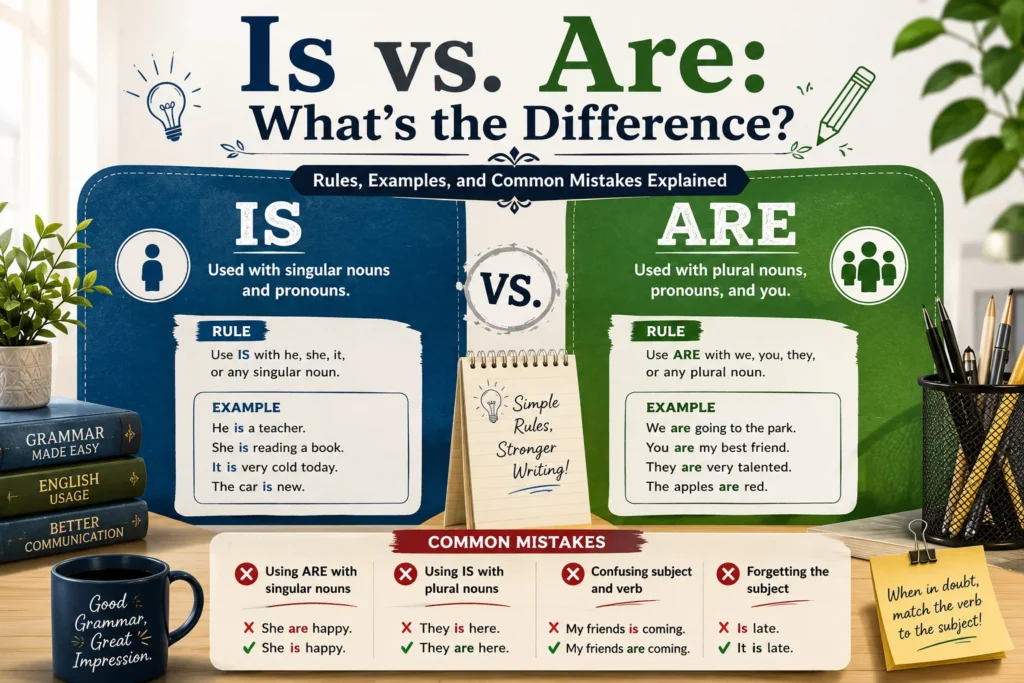
Using Is vs. Are correctly becomes easier when you learn clear rules, improve sentence structure, and build confidence through regular writing.Many people think choosing between is vs are is simple, but a longer sentence or several sentences can quickly become tricky. A team, family, or group may look easy, yet many reasons make everyone ask questions. The good news is that when you follow clear rules, you understand subject-verb agreement, grammar, and English grammar with greater confidence. This guide explains the difference, functional difference, and the correct use of these forms in everyday English. From my experience helping learners, getting it right no longer feels like crossing a minefield where one wrong step, word, or mix creates confusion. Instead of tackling explosives, these little words pack a powerful punch, guiding your precision so every sentence makes sense.
At first glance, the landscape of English grammar looks like a classic conundrum that trips many learners, but once you dive deeper, the main difference lies in matching subjects with the correct verbs. A singular noun, pronoun, or noun/pronoun can represent one person, place, thing, or idea, so it is paired with is. For instance, the cat is sleeping, while plural nouns, pronouns, and cats take are. A useful way to remember is to replace the subject with it or they. If it fits, choose is; if they fit, choose are. This helps you write correctly, improves your understanding, and creates a proper foundation for mastering the present, present tense, and present-tense forms of the verb, the verb be. This be verb is pivotal in constructing grammatically correct sentences because it shows identity, qualities, and conditions. Third, third person, and third-person subjects like he, she, John, and Florida usually take is, while second person, second-person you, we, and I, including combinations like Jack and Diane, show the broader scope of are, irrespective of the people involved.
This article aims to demystify the distinction by ensuring students grasp the application through examples, delving into grammatical roles, and illustrate why these functional patterns matter. The goal is equipping you with knowledge to avoid common pitfalls because these verbs are an integral part of the language and essential for anyone looking to improve linguistic clarity. The challenge comes when someone is learning English as a second language, where the choice depends on the subject and may confuse even a careful writer. By breaking the topic down, I provide and explain how using these verbs supports forming natural communication, speaking, professional conversations, and avoiding sounding awkward or incorrect. This approach can enhance fluency in every situation and different situations, making communication more effective until the end of each lesson confidently. Commonly and frequently, the important point is to know what determines the verb and whether one or all plurals need is or are. Keep this quick summary in mind, and your agreement with every subject will lead to stronger and better communication.
What Are “Is” and “Are”?
Both is and are are present-tense forms of the verb to be.
The verb to be helps describe:
- Identity
- Existence
- Location
- Condition
- State of being
For example:
- The book is interesting.
- The students are ready.
- My office is downtown.
- The children are excited.
Without forms of the verb to be, many English sentences would not work.
Understanding the Verb “To Be”
The verb to be is one of the oldest and most frequently used verbs in English.
Here are its present-tense forms:
| Subject | Verb Form |
| I | Am |
| You | Are |
| He | Is |
| She | Is |
| It | Is |
| We | Are |
| They | Are |
A simple way to remember this table is:
Singular subjects usually take “is.” Plural subjects usually take “are.”
That single rule solves most grammar problems.
How “Is” and “Are” Function in a Sentence
These verbs often connect the subject to additional information.
Examples:
- Sarah is a doctor.
- The dogs are friendly.
- The weather is beautiful.
- The houses are expensive.
In each sentence, the verb links the subject to a description or fact.
Present Tense Forms of the Verb “To Be”
Here are common examples:
| Subject | Example |
| I | I am tired. |
| You | You are welcome. |
| He | He is busy. |
| She | She is happy. |
| It | It is raining. |
| We | We are ready. |
| They | They are waiting. |
Understanding this chart creates the foundation for mastering is vs. are.
When to Use “Is”
Use is with singular subjects.
A singular subject refers to one person, place, thing, or idea.
Using “Is” With Singular Nouns
Examples:
- The car is fast.
- The building is old.
- My friend is here.
- The restaurant is crowded.
Each noun refers to one thing.
Using “Is” With Singular Pronouns
Use is after:
- He
- She
- It
Examples:
- He is a teacher.
- She is my neighbor.
- It is cold outside.
These pronouns always require is in the present tense.
Examples of “Is” in Everyday Sentences
At work:
- The meeting is at noon.
- The report is complete.
At school:
- The assignment is due tomorrow.
- The classroom is quiet.
At home:
- The dinner is ready.
- The television is on.
Situations Where “Is” Sounds Most Natural
You will often use is when discussing:
- One person
- One object
- One location
- One idea
- One event
Examples:
- Success is rewarding.
- The conference is tomorrow.
- The package is delayed.
When to Use “Are”
Use are when the subject is plural.
Plural means more than one.
Using “Are” With Plural Nouns
Examples:
- The cars are parked outside.
- The students are studying.
- The books are on the shelf.
- The flowers are blooming.
Using “Are” With Pronouns
Use are with:
- You
- We
- They
Examples:
- You are correct.
- We are ready.
- They are excited.
One interesting exception exists.
Even when referring to one person, English uses:
- You are
Never:
- You is
Examples of “Are” in Everyday Communication
- The employees are attending training.
- The children are playing.
- The stores are open.
- The documents are complete.
Recognizing Plural Subjects Quickly
Look for clues such as:
- Nouns ending in -s
- Words like many, several, numerous
- Pronouns such as they and we
Examples:
- Many people are waiting.
- Several books are missing.
- The workers are arriving.
The Simple Rule That Solves Most “Is” vs. “Are” Problems
Most mistakes disappear when you identify the subject first.
Singular Subject = Is
Examples:
- The dog is sleeping.
- My sister is a lawyer.
- The chair is broken.
Plural Subject = Are
Examples:
- The dogs are sleeping.
- My sisters are lawyers.
- The chairs are broken.
Quick Subject Identification Techniques
Ask:
Who or what is the sentence about?
Example:
- The box of apples is heavy.
The subject is box, not apples.
Correct:
- The box of apples is heavy.
Incorrect:
- The box of apples are heavy.
Practice Examples
| Sentence | Correct Verb |
| The teacher ___ kind. | Is |
| The teachers ___ kind. | Are |
| The dog ___ barking. | Is |
| The dogs ___ barking. | Are |
Is vs. Are With Different Types of Nouns
Not all nouns behave the same way.
Common Nouns
Examples:
- The chair is comfortable.
- The chairs are comfortable.
Proper Nouns
Examples:
- Michael is late.
- Michael and Sarah are late.
Countable and Uncountable Nouns
Countable nouns can be counted.
Examples:
- Books
- Cars
- Computers
Uncountable nouns cannot usually be counted individually.
Examples:
- Water
- Information
- Advice
- Furniture
Correct usage:
- Water is essential.
- Information is valuable.
- Advice is helpful.
Many learners mistakenly treat these nouns as plural.
Abstract Nouns
Abstract nouns represent ideas and concepts.
Examples:
- Love is powerful.
- Knowledge is valuable.
- Freedom is important.
However:
- Ideas are valuable.
- Beliefs are influential.
Collective Nouns and Tricky Cases
Collective nouns often create confusion.
Team, Family, Group, and Class
A collective noun refers to multiple individuals acting as one unit.
Examples:
- The team is winning.
- The family is traveling.
- The class is quiet.
In American English, collective nouns usually take is.
When Collective Nouns Take “Are”
Sometimes the focus shifts to individual members.
Examples:
- The team are arguing among themselves.
- The family are arriving separately.
This usage appears more frequently in British English.
Examples That Commonly Confuse Learners
| Sentence | Preferred American English |
| The committee is meeting today. | Correct |
| The committee are meeting today. | Less common |
| The team is playing tonight. | Correct |
| The team are playing tonight. | Mostly British English |
Is vs. Are in Questions
Questions require a slightly different structure.
Forming Questions With “Is”
Examples:
- Is she ready?
- Is the office open?
- Is the food fresh?
Notice that is appears before the subject.
Forming Questions With “Are”
Examples:
- Are they coming?
- Are the stores open?
- Are we late?
Common Question Patterns
Many English questions follow this formula:
Verb + Subject + Additional Information
Examples:
- Is he home?
- Are they ready?
- Is the project finished?
- Are the students prepared?
Question Word + Is/Are Structure
Examples:
- What is your name?
- Where is the station?
- Why are they upset?
- How are you today?
These patterns appear constantly in everyday conversation.
Is vs. Are in Negative Sentences
Negative statements use not.
Using “Is Not” and “Isn’t”
Examples:
- He is not available.
- He isn’t available.
- The office isn’t open.
Using “Are Not” and “Aren’t”
Examples:
- They aren’t ready.
- We aren’t finished.
- The stores aren’t open.
Common Negative Sentence Examples
| Positive | Negative |
| She is here. | She isn’t here. |
| They are ready. | They aren’t ready. |
| The meeting is today. | The meeting isn’t today. |
| The students are prepared. | The students aren’t prepared. |
Formal vs. Informal Usage
Formal writing often uses:
- Is not
- Are not
Informal speech usually prefers:
- Isn’t
- Aren’t
Both are grammatically correct.
There Is vs. There Are
This is one of the most common grammar topics in English.
What “There Is” Means
Use there is with singular nouns.
Examples:
- There is a problem.
- There is a chair in the room.
- There is an opportunity available.
What “There Are” Means
Use there are with plural nouns.
Examples:
- There are several problems.
- There are many chairs.
- There are two opportunities.
Singular and Plural Rules
| Structure | Example |
| There is + singular noun | There is a cat outside. |
| There are + plural noun | There are cats outside. |
Examples in Real-Life Situations
- There is a message for you.
- There are five messages for you.
- There is one mistake.
- There are many mistakes.
Common Errors With There Is and There Are
Incorrect:
- There is many reasons.
Correct:
- There are many reasons.
Incorrect:
- There is several books.
Correct:
- There are several books.
Is vs. Are With Compound Subjects
Compound subjects contain multiple parts.
Subjects Joined by “And”
Generally use are.
Examples:
- Jack and Emma are friends.
- The manager and assistant are present.
Subjects Joined by “Or”
The verb usually agrees with the nearest subject.
Examples:
- Either the teacher or the students are responsible.
- Either the students or the teacher is responsible.
Subjects Joined by “Nor”
Examples:
- Neither the manager nor the employees are available.
- Neither the employees nor the manager is available.
The Nearest Subject Rule Explained
Look at the noun closest to the verb.
That noun usually determines whether you choose is or are.
Is vs. Are With Indefinite Pronouns
Indefinite pronouns often look plural even when they are singular.
Everyone, Someone, Anybody, Nobody
These words are grammatically singular.
Correct examples:
- Everyone is welcome.
- Someone is calling.
- Nobody is perfect.
- Anybody is eligible.
Why Singular Pronouns Use “Is”
These words refer to one unspecified person at a time.
Therefore they take singular verbs.
Examples and Exceptions
Correct:
- Everybody is excited.
Incorrect:
- Everybody are excited.
Correct:
- Someone is waiting.
Incorrect:
- Someone are waiting.
Common Is vs. Are Mistakes and How to Fix Them
Even experienced writers make mistakes.
Mistaking Singular and Plural Subjects
Incorrect:
- The list of items are long.
Correct:
- The list of items is long.
The subject is list.
Ignoring Intervening Words
Incorrect:
- The box of toys are heavy.
Correct:
- The box of toys is heavy.
Errors With Collective Nouns
Incorrect:
- The team are winning. (American English)
Preferred:
- The team is winning.
Errors in Questions
Incorrect:
- Are she ready?
Correct:
- Is she ready?
Errors in There Is/There Are Constructions
Incorrect:
- There is three cars outside.
Correct:
- There are three cars outside.
Is vs. Are in American English vs. British English
Regional differences can affect verb choice.
Key Differences in Collective Nouns
American English treats collective nouns as singular more often.
Examples:
- The team is winning.
- The government is announcing changes.
British English sometimes treats these nouns as plural.
Examples:
- The team are winning.
- The government are debating the proposal.
Examples of Regional Variations
| American English | British English |
| The team is winning. | The team are winning. |
| The staff is working. | The staff are working. |
| The government is planning changes. | The government are planning changes. |
Which Usage Is More Common Today?
In American English, singular treatment remains the standard approach for collective nouns.
Quick Reference Chart for Is vs. Are
| Use Is | Use Are |
| He | You |
| She | We |
| It | They |
| Someone | Many people |
| Everyone | Several books |
| The dog | The dogs |
| The house | The houses |
| The team | The teams |
Is vs. Are Practice Exercises
Fill-in-the-Blank Questions
- The teacher ___ helpful.
- The teachers ___ helpful.
- There ___ a problem.
- There ___ many problems.
- Everyone ___ excited.
Answers
- Is
- Are
- Is
- Are
- Is
Error Correction Exercises
Correct the following:
- There is many books.
- Everybody are welcome.
- The students or the teacher are responsible.
Correct answers:
- There are many books.
- Everybody is welcome.
- The students or the teacher are responsible.
Conclusion
Understanding is-vs-are becomes much easier once you focus on subject-verb agreement instead of memorising random rules. Whether your subject is singular or plural, choosing the correct verb helps you create clear and natural sentences. With regular practice, careful writing, and simple examples, you can avoid common grammar mistakes and communicate with greater confidence in both spoken and written English.
FAQs
Q1. What is the main difference between is and are?
Is is used with a singular noun or pronoun, while are is used with plural nouns, pronouns, and the pronoun you. The correct choice always depends on the subject of the sentence.
Q2. How can I remember when to use is or are?
A simple trick is to replace the subject with it or they. If it sounds correct, use is. If they sounds natural, use are.
Q3. Why do learners confuse is-vs-are?
Many learners become confused because some collective words like team, family, and group may look singular but can sometimes be treated differently depending on the style of English being used.
Q4. Does using the correct verb improve my writing?
Yes. Correct subject-verb agreement makes your sentence structure stronger, improves clarity, and helps your communication sound more natural and professional.
Q5. What is the best way to master is and are?
Practice by reading, writing, and speaking every day. Review examples, learn the basic rules, and check your sentences to make sure the subject matches the correct verb.

I translate “complicated grammar” into simple, visual language that any person can learn fast. I believe English confidence is not about perfection — it’s about clarity and impact. Every guide I publish is designed to help you speak smarter, write sharper, and feel more powerful in English.