
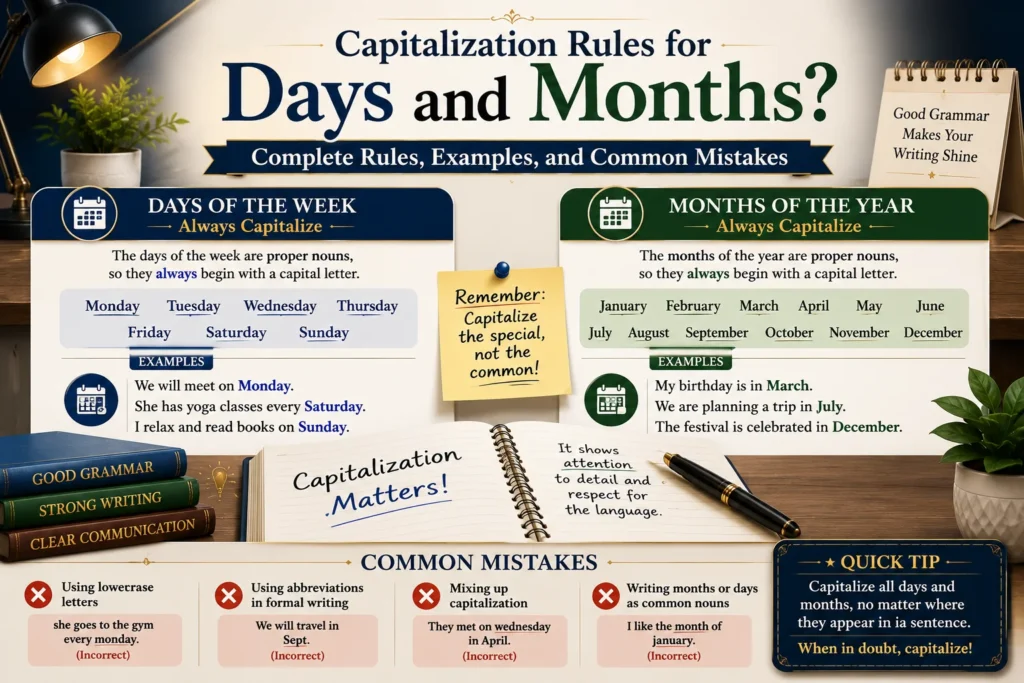
The keyword Capitalization Rules for Days and Months explains why capitalization in English matters every day.When I began improving my English writing, I often paused while drafting an email because I was unsure whether Monday should be Monday or January should be January. After learning capitalization rules and English grammar, everything became clearer. The days of the week and months of the year are proper nouns, so you should always capitalize them with a capital letter as the first letter in uppercase. Monday, Tuesday, Wednesday, Thursday, Friday, Saturday, Sunday, January, February, March, April, May, June, July, August, September, October, November, and December are unique names that act as time markers and time-related words, making communication, clarity, and correctness much better for readers.
Unlike common nouns, common noun words, general time expressions, or seasons, these names are always capitalized. It also helps to compare Monday vs Monday, January vs January, March vs march, and February vs February to understand the correct lowercase forms and uppercase usage. I usually remind every student, professional, blogger, and teacher that proper capitalization is easier to remember when you think of these words as official names instead of ordinary nouns. While planning schedules, preparing documents, writing examples, or mentioning special occasions, this habit improves writing, writing clarity, writing correctness, grammar accuracy, and overall English writing.
Many writers have wondered and questioned why these words require capitalization, but the answer is quite straightforward. Their uniqueness, importance, importance in sentences, and connection with time make them different from a season or words used outside a title or title case. From my experience, getting the hang of capitalization first felt like a hike up a steep mountain, but later became a walk in the park. Once you start knowing the pattern, you can apply it immediately with respect because these words deserve careful use. Helpful ideas such as brass tacks, good news, stand tall, shutout, park, mountain, punctuation context, language, version, guide, style guide, style guide differences, practical examples, capitalize days, capitalize months, capitalizing days, capitalizing months, identify, identify words, communicate, clearly, confidently, learn, understanding, improve, distinguish, occasion, week, month, year, start, always, first, letter, uppercase letter, correct, not capitalized, grammar rules, remember, remembering, help, confuse, sentence, sentences, schedule, capitalizing, months, days, proper noun, and first big letter all reinforce the same writing habit.
The Short Answer: Are Days and Months Capitalized?
Yes. Days of the week and months of the year are always capitalized in English.
This rule applies whether the words appear:
- At the beginning of a sentence
- In the middle of a sentence
- In formal writing
- In casual writing
- In emails
- In academic papers
- In books
- In social media posts
Why Days of the Week Are Always Capitalized
The names of days are treated as proper nouns.
A proper noun identifies a specific name rather than a general category. Since each day has its own unique name, English grammar requires capitalization.
Examples:
✅ I will visit my grandparents on Saturday.
✅ The meeting is scheduled for Tuesday morning.
✅ We usually exercise every Monday.
Incorrect examples:
❌ I will visit my grandparents on saturday.
❌ The meeting is scheduled for tuesday morning.
Even in informal messages, capitalization remains the standard rule.
Why Months of the Year Are Always Capitalized
Months follow the same principle.
Each month represents a specific named period within the calendar year.
Examples:
✅ My birthday is in June.
✅ The conference begins in September.
✅ We moved here in December.
Incorrect examples:
❌ My birthday is in june.
❌ The conference begins in september.
Whether you’re writing a text message or a university dissertation, the capitalization rule stays the same.
The Grammar Rule Behind Capitalization
The reason is simple.
Days and months function as proper nouns, and proper nouns always begin with a capital letter.
Think about these examples:
| Proper Noun | Common Noun |
| Monday | day |
| January | month |
| Paris | city |
| Amazon | river/company |
| Sarah | person |
Notice the pattern. Specific names receive capitalization. General categories do not.
Understanding Proper Nouns and Capitalization
To fully understand why days and months are capitalized, it helps to understand the difference between proper nouns and common nouns.
What Makes a Word a Proper Noun?
A proper noun names a particular person, place, organization, event, or thing.
Examples include:
- America
- Christmas
- Michael
- Wednesday
- October
Because these words identify specific entities, English grammar capitalizes them.
Why Days and Months Are Treated as Proper Names
Historically, many day and month names originated from ancient deities, rulers, and cultural traditions.
For example:
- Thursday comes from Thor, the Norse god of thunder.
- Wednesday derives from Odin (Woden).
- January is named after Janus, the Roman god of beginnings.
- March honors Mars, the Roman god of war.
Over time, these names became fixed parts of the calendar.
Since they represent unique names rather than generic categories, capitalization became standard.
Proper Nouns vs. Common Nouns Explained
Consider these examples:
| Correct | Why |
| Monday | Specific day |
| day | General category |
| January | Specific month |
| month | General category |
| Christmas | Specific holiday |
| holiday | General category |
A simple rule helps:
If the word names a specific thing, capitalize it. If it describes a general category, use lowercase.
Capitalization Rules for Days of the Week
The seven days of the week always begin with capital letters.
Monday, Tuesday, Wednesday, Thursday, Friday, Saturday, and Sunday
Here are the correct spellings:
| Day | Correct Capitalization |
| Monday | ✅ |
| Tuesday | ✅ |
| Wednesday | ✅ |
| Thursday | ✅ |
| Friday | ✅ |
| Saturday | ✅ |
| Sunday | ✅ |
Every day follows the same rule.
No exceptions exist in standard English.
Days Used in Sentences
Examples:
✅ We arrived on Friday.
✅ Sunday is usually my rest day.
✅ The project starts next Wednesday.
Notice that capitalization remains unchanged regardless of sentence placement.
Days Used in Titles and Headlines
Days stay capitalized in titles.
Examples:
- Monday Morning Productivity Tips
- Why Friday Feels Different
- Sunday Planning Habits for Success
The capitalization comes from the day’s status as a proper noun.
Days Used in Calendars and Schedules
Calendars universally capitalize day names.
Example:
| Time | Event |
| Monday | Team Meeting |
| Tuesday | Client Call |
| Wednesday | Training |
| Thursday | Project Review |
| Friday | Weekly Report |
This formatting creates consistency and improves readability.
Capitalization Rules for Months of the Year
Just like days, every month receives capitalization.
January Through December: The Complete Rule
The correct forms are:
- January
- February
- March
- April
- May
- June
- July
- August
- September
- October
- November
- December
Each begins with a capital letter.
Months in Dates
Examples:
✅ January 5, 2026
✅ October 12, 2026
✅ March 18, 2026
The month remains capitalized regardless of formatting style.
Months Used Without Specific Dates
Many writers incorrectly assume capitalization is required only when dates are present.
That’s false.
Examples:
✅ I was born in August.
✅ We plan to travel in April.
✅ Sales usually increase in December.
The month name remains capitalized even when no date appears.
Months in Formal and Informal Writing
Whether you’re writing:
- A business proposal
- A social media caption
- A research paper
- A text message
- A resume
The rule remains unchanged.
Correct capitalization never depends on formality.
Do You Capitalize Abbreviated Days and Months?
Yes.
Abbreviations also require capitalization.
Common Day Abbreviations
| Full Day | Abbreviation |
| Monday | Mon. |
| Tuesday | Tue. |
| Wednesday | Wed. |
| Thursday | Thu. |
| Friday | Fri. |
| Saturday | Sat. |
| Sunday | Sun. |
Examples:
✅ Meeting on Mon.
✅ Delivery expected by Fri.
Common Month Abbreviations
| Month | Abbreviation |
| January | Jan. |
| February | Feb. |
| March | Mar. |
| April | Apr. |
| August | Aug. |
| September | Sept. |
| October | Oct. |
| November | Nov. |
| December | Dec. |
Business and Academic Writing Examples
Examples:
✅ Report submitted on Jan. 15.
✅ Seminar scheduled for Sept. 8.
✅ Budget review planned for Oct. 22.
Abbreviating does not eliminate capitalization.
Words Related to Days and Months That Are Not Capitalized
This area creates the most confusion.
Many writers capitalize words that should remain lowercase.
Seasons Are Usually Not Capitalized
Unlike months and days, seasons are common nouns.
Correct examples:
✅ spring
✅ summer
✅ fall
✅ winter
Examples in sentences:
✅ We travel during the summer.
✅ The flowers bloom in spring.
Incorrect:
❌ We travel during the Summer.
❌ The flowers bloom in Spring.
Exception: capitalize seasons when they appear in official names.
Examples:
- Winter Olympics
- Summer Games
- Spring Semester
Decades and Centuries
These remain lowercase.
Examples:
✅ the 1990s
✅ the twenty-first century
✅ the nineteenth century
Time Periods Such as Morning, Afternoon, and Evening
These words are not proper nouns.
Examples:
✅ morning
✅ afternoon
✅ evening
✅ night
Example sentence:
✅ I’ll call you tomorrow morning.
Not:
❌ I’ll call you tomorrow Morning.
When Capitalization Rules Change
Although days and months are always capitalized, certain writing situations create confusion. Understanding these situations helps you avoid mistakes and maintain consistency.
Capitalizing Days and Months at the Beginning of a Sentence
Every sentence begins with a capital letter. Since day and month names are already capitalized, nothing changes.
Examples:
✅ Monday will be our busiest day.
✅ January marks the beginning of the fiscal year.
✅ Thursday is the deadline for submissions.
The capitalization rule remains exactly the same.
Days and Months in Titles and Headlines
Titles often follow special capitalization rules. Fortunately, days and months stay capitalized regardless of the title style.
Examples:
- Why January Is the Best Month to Set Goals
- Monday Productivity Habits That Actually Work
- How December Spending Affects Your Budget
Even when a publication uses sentence case, proper nouns remain capitalized.
Days and Months in Quotations
Quoted text follows standard capitalization rules.
Examples:
“The event starts on Friday.”
“We moved here in September.”
The quotation marks do not affect capitalization.
Days and Months in Email Subject Lines
Professional emails frequently include days and months.
Examples:
- Meeting Scheduled for Tuesday
- January Sales Report
- Friday Project Update
- December Budget Review
Capitalization improves readability and creates a more polished appearance.
Common Capitalization Mistakes Writers Make
Even experienced writers occasionally make capitalization errors. Most mistakes come from misunderstanding proper nouns or copying informal online writing.
Writing Month Names in Lowercase
This is one of the most common mistakes.
Incorrect:
❌ january
❌ february
❌ december
Correct:
✅ January
✅ February
✅ December
Many people develop this habit because text messages and social media platforms often encourage casual writing.
Confusing Seasons With Months
Months are capitalized.
Seasons are generally lowercase.
| Correct | Incorrect |
| January | january |
| October | october |
| spring | Spring |
| summer | Summer |
This distinction causes confusion because both refer to periods of time.
Remember:
- Months = Capitalized
- Seasons = Usually lowercase
Inconsistent Capitalization Within the Same Document
Some writers capitalize a month correctly once and incorrectly later.
Example:
✅ We launched the campaign in March.
❌ Revenue increased during march.
Consistency matters.
Professional writing should apply the same rule throughout the document.
Errors Caused by Autocorrect and AI Tools
Technology helps writers. However, it isn’t perfect.
Common issues include:
- Lowercase month names copied from databases
- Formatting changes during content migration
- Inconsistent capitalization from automated systems
- User-generated content with mixed formatting
Always proofread important documents before publishing.
Days and Months in Different Writing Styles
One reason people become confused about capitalization is that style guides differ on many formatting rules.
However, capitalization of days and months remains remarkably consistent.
APA Style Rules for Capitalizing Days and Months
The American Psychological Association (APA) style is common in education and research.
APA style requires capitalization of:
- Days of the week
- Months of the year
- Holidays
Examples:
✅ Monday
✅ September
✅ Thanksgiving
APA does not capitalize:
- spring
- summer
- fall
- winter
Unless they appear in official titles.
MLA Style Rules for Days and Months
The Modern Language Association (MLA) style is widely used in humanities disciplines.
MLA follows the same capitalization rule:
Examples:
✅ Tuesday
✅ April
✅ November
No special exceptions exist for normal usage.
Chicago Manual of Style Rules
Many publishers and book authors follow the Chicago Manual of Style.
Chicago style also capitalizes:
- Days
- Months
- Holidays
Examples:
✅ Wednesday
✅ October
✅ Christmas
Again, seasons generally remain lowercase.
AP Style Rules for Journalists
News organizations often use Associated Press (AP) style.
AP style capitalizes all day and month names.
Examples:
✅ Friday
✅ December
✅ Monday
The primary AP differences involve date formatting and abbreviations rather than capitalization.
Quick Style Guide Comparison
| Style Guide | Days Capitalized | Months Capitalized |
| APA | Yes | Yes |
| MLA | Yes | Yes |
| Chicago | Yes | Yes |
| AP | Yes | Yes |
This consistency makes capitalization easier to remember.
Capitalization Rules in American English vs. British English
Many grammar rules differ between American and British English.
Examples include:
- Color vs. Colour
- Organize vs. Organise
- Center vs. Centre
Fortunately, capitalization of days and months does not change.
Similarities Between American and British English
Both forms capitalize:
- Monday
- Tuesday
- January
- February
- Christmas
Examples:
American English:
✅ The meeting is on Monday.
British English:
✅ The meeting is on Monday.
No difference exists.
Minor Formatting Differences
The main variation appears in date formatting.
American format:
January 15, 2026
British format:
15 January 2026
Notice that the month remains capitalized in both cases.
Examples From Real-World Writing
Business communication:
✅ The contract begins on Monday, 12 October.
Academic writing:
✅ Research started in September.
Government documents:
✅ Applications close in December.
The capitalization rule stays consistent across English-speaking countries.
Examples of Correct and Incorrect Capitalization
Seeing examples side by side often makes grammar rules easier to understand.
Everyday Conversation Examples
| Correct | Incorrect |
| I’ll see you on Saturday. | I’ll see you on saturday. |
| We moved in July. | We moved in july. |
| The game starts Tuesday. | The game starts tuesday. |
| School begins in August. | School begins in august. |
Academic Writing Examples
Correct:
✅ Data collection began in March 2025.
✅ Participants attended sessions every Wednesday.
Incorrect:
❌ Data collection began in march 2025.
❌ Participants attended sessions every wednesday.
Business Email Examples
Correct:
✅ The presentation is scheduled for Friday.
✅ Please submit reports by October 1.
Incorrect:
❌ The presentation is scheduled for friday.
❌ Please submit reports by october 1.
Social Media Examples
While social media often encourages casual language, proper capitalization still improves readability.
Example:
✅ Looking forward to our trip this December!
Looks more polished than:
❌ Looking forward to our trip this december!
Case Study: How a Small Error Can Affect Professional Writing
Imagine two job applicants.
Applicant A writes:
Available to start work in september.
Applicant B writes:
Available to start work in September.
The difference seems minor.
However, recruiters often view grammar and formatting as indicators of attention to detail.
One small capitalization error won’t necessarily cost someone a job. Yet repeated mistakes can make writing appear rushed or unprofessional.
This example highlights an important truth:
Good grammar builds credibility before you even meet the reader.
Quick Reference Chart for Capitalizing Days and Months
Correct Usage Table
| Word Type | Example | Capitalized? |
| Day | Monday | Yes |
| Day | Friday | Yes |
| Month | January | Yes |
| Month | October | Yes |
| Holiday | Christmas | Yes |
| Holiday | Thanksgiving | Yes |
Lowercase Usage Table
| Word Type | Example | Capitalized? |
| Season | spring | No |
| Season | winter | No |
| Time of Day | morning | No |
| Time of Day | evening | No |
| General Period | century | No |
| General Period | decade | No |
Easy Rules to Remember
Keep these three simple rules in mind:
✅ Capitalize all days of the week.
✅ Capitalize all months of the year.
✅ Do not capitalize seasons unless they are part of a formal name.
A single memory trick can help:
If it appears on a calendar as a specific name, capitalize it.
Monday qualifies.
January qualifies.
Conclusion
Learning the capitalization of the days of the week and months of the year is one of the easiest English grammar rules to master. Since these words are proper nouns, they always begin with a capital letter, helping your writing look more professional and easier to read. By practising this simple habit, you can avoid common mistakes, improve clarity, and communicate with greater confidence in every email, document, or assignment.
FAQs
Q1. Should the days of the week always be capitalized?
Yes. Monday, Tuesday, Wednesday, Thursday, Friday, Saturday, and Sunday are proper nouns, so they should always start with a capital letter.
Q2. Are months always written with capital letters?
Yes. January through December are always capitalized because they are the official names of the months of the year.
Q3. Why are seasons not capitalized like months and days?
Words such as spring, summer, autumn, and winter are usually common nouns, so they are not capitalized unless they appear in a title or are part of a proper name.
Q4. Is it wrong to write “monday” or “january” in lowercase?
Yes. In standard English writing, Monday and January are incorrect. The correct forms are Monday and January.
Q5. How can I remember this capitalization rule?
A simple trick is to think of the days and months as unique names on a calendar. Since they are proper nouns, always begin them with a capital letter.

Sarah Johnson is a Language Teacher who explains English rules in simple everyday examples.She creates practical lessons for GrammarVerb so learners can improve their writing and communication skills. Her purpose is to make English learning clear, enjoyable, and easy to use in real life.