Is “and I’s” Correct Grammar often comes up when people are learning English grammar, because grammar rules can feel different while mastering English in real life. Many learners and even native speakers struggle with subject-verb agreement, constructing sentences, and sentence construction, especially when a common mistake like the phrase “And I’s” appears in casual speech. It may sound natural, but it is not proper grammar or standard writing, and it often creates issues with possessive forms and incorrect possessive forms, leading to confusion between plural, possessive, and plural vs possessive forms. I have often seen this misunderstanding in everyday writing, where it becomes misused and reduces clarity, precision, communication, and credibility for readers in both writing and speaking.
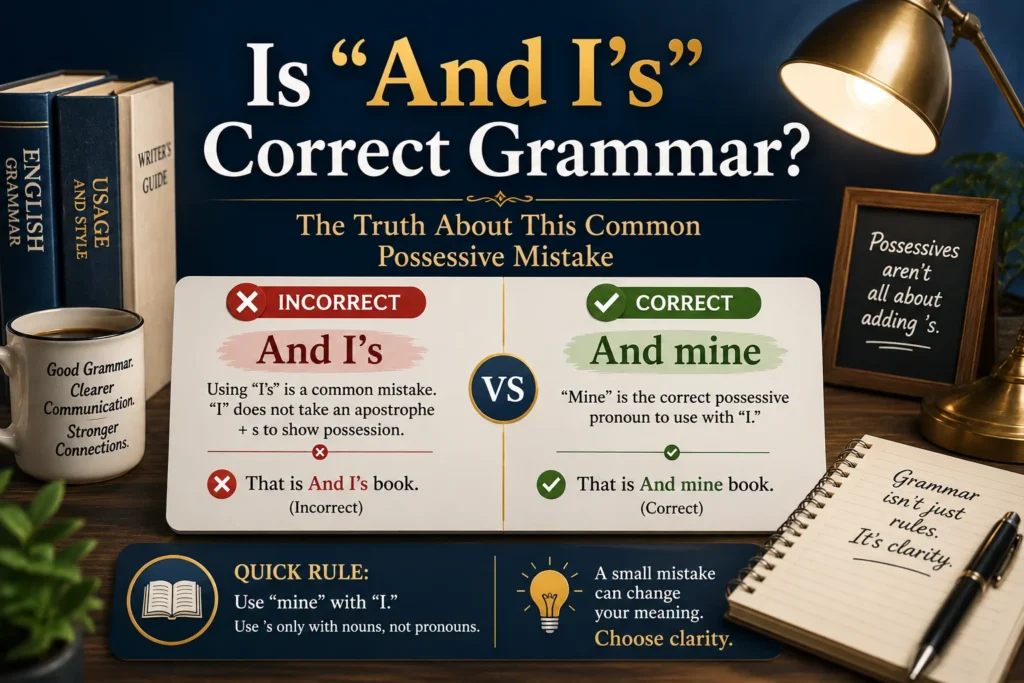
The real issue comes from ownership rules in the English language, especially when trying to show ownership. The correct form is “and my”, not “And I’s”, even when something belongs to more than one person, such as John and my book instead of John and I’s book. Here, John, book, name, other person, noun, nouns, pronoun, pronouns, my, “I”, I’s, and adding ’s show why possessive construction and possessive constructions matter so much. Since “I” is a pronoun, adding ’s does not create a possessive pronoun. Instead, we use my before the noun and combine it with another name or pronoun to form the right combination, ensuring correct use, correct possessive, correct usage, grammar usage, usage rules, and overall grammar accuracy.
From my experience working with article writing, I noticed that people often need to navigate grammar like a puzzle, where every piece follows rules, but also has exceptions. Each picture must make sense in its context, and that is where most grammar mistake issues happen. When you reach this stage of grammar learning, it helps to remember key areas like verb forms, verb agreement, syntax, word forms, language structure, language rules, language, usage, and speech, along with avoiding pitfalls that can undermine communication skills, writing skills, English communication, communication clarity, sentence clarity, sentence accuracy, correct sentence, correct grammar, incorrect grammar, standard grammar, standard English, proper English, grammatical correctness, language mastery, language learning, language confusion, ownership expression, formal writing, informal speech, precision in writing, English learners, English writing, and overall communication skills.
What Does “And I’s” Mean?
The phrase “and I” usually appears when someone wants to show shared ownership.
Consider this sentence:
My wife’s and my car is parked outside.
The speaker means that both the speaker and their wife own the car together.
The phrase attempts to create a possessive form from the expression “my wife and I.”
In everyday conversation, people often create possessives by adding apostrophe-s to a complete phrase. That habit leads many speakers to say “and I’s.”
Why People Say “And I’s”
The phrase develops naturally in speech.
Most people understand that ownership often requires an apostrophe:
- John’s car
- Mary’s house
- David’s laptop
When speakers want to express shared ownership, they sometimes apply the same pattern to an entire phrase.
For example:
- John and Mary’s business
- Sarah and Tom’s apartment
Then they try to use the same structure with a pronoun:
- Sarah and I’s apartment
The result sounds logical to many speakers even though traditional grammar treats it differently.
Common Examples of “And I’s”
You may hear phrases such as:
- My friend and I’s presentation
- My husband and I’s dog
- My sister and I’s vacation
- My colleague and I’s report
- My roommate and I’s lease
These expressions appear frequently in casual conversation, social media posts, podcasts, and even professional environments.
Is “And I’s” Grammatically Correct?
The Short Answer
No. “And I’s” is not considered standard English grammar.
The reason is simple.
The possessive form of I is not I’s.
English already has possessive forms for the pronoun I:
| Pronoun | Possessive Determiner | Possessive Pronoun |
| I | my | mine |
Examples:
- My book
- My car
- Mine is blue
Notice something important.
English does not create possession by turning I into I’s.
Instead, English uses my and mine.
That is why grammar authorities generally reject constructions like:
- I’s car
- I’s house
- I’s project
Since I’s itself is nonstandard, phrases like John and I’s project become problematic.
Understanding Possessive Pronouns
English pronouns already have built-in possessive forms.
Here is a complete reference table.
| Subject Pronoun | Possessive Determiner | Possessive Pronoun |
| I | my | mine |
| You | your | yours |
| He | his | his |
| She | her | hers |
| It | its | its |
| We | our | ours |
| They | their | theirs |
Unlike nouns, pronouns do not normally take apostrophe-s.
Compare the difference:
| Noun | Possessive Form |
| John | John’s |
| Sarah | Sarah’s |
| Teacher | Teacher’s |
But with pronouns:
| Pronoun | Possessive Form |
| I | my/mine |
| We | our/ours |
| They | their/theirs |
That distinction explains why “and I’s” creates grammatical tension.
Why “My Wife and I’s Car” Is Incorrect
Let’s break the sentence apart.
The Sentence
My wife and I’s car
The ownership phrase is intended to describe a car owned by both people.
Now remove the first noun.
The sentence becomes:
I’s car
The problem becomes obvious.
“I’s a car” does not follow English grammar rules.
The correct possessive form would be:
My car
Since the simplified version is incorrect, the full phrase remains incorrect as well.
The Removal Test
Grammar experts often use a quick test.
Remove the other person from the phrase.
Examples:
| Original Phrase | After Removal | Result |
| John and I’s project | I’s project | Incorrect |
| Sarah and I’s apartment | I’s apartment | Incorrect |
| My wife and I’s car | I’s car | Incorrect |
The test immediately reveals the issue.
Why Native Speakers Still Use It
Language is not always logical.
Many expressions become popular because they sound natural.
Speakers often think in chunks rather than individual grammar rules.
Instead of analyzing every word, people process:
My wife and I
as one unit.
They then attach possession to the entire phrase.
This explains why and I’s appears frequently despite being considered nonstandard.
Understanding Joint Ownership in English
Joint ownership creates unique grammatical challenges.
When two people own something together, English offers several ways to express that relationship.
Shared Ownership
Examples:
- Jack and Emma’s house
- Michael and Sophia’s company
- Liam and Olivia’s restaurant
These examples work because both names are nouns.
The apostrophe-s attaches to the final noun.
Separate Ownership
Consider this example:
- Jack’s and Emma’s cars
This sentence means Jack owns one car and Emma owns another.
Notice the difference.
| Structure | Meaning |
| Jack and Emma’s car | Shared ownership |
| Jack’s and Emma’s cars | Separate ownership |
Understanding this distinction helps avoid confusion when discussing possessives.
The Best Alternatives to “And I’s”
Fortunately, several alternatives sound natural and follow standard grammar.
Use “Our”
Often the simplest solution is the best one.
Instead of:
My wife and I’s house
Write:
Our house
Instead of:
John and I’s presentation
Write:
Our presentation
Instead of:
Sarah and I’s project
Write:
Our project
This approach creates clarity instantly.
Use a Full Ownership Phrase
Another option involves rewriting the sentence.
Examples:
- The house that my wife and I own
- The project John and I completed
- The apartment Sarah and I rented
These versions eliminate awkward grammar.
Use “Belonging To”
Sometimes clarity matters more than brevity.
Examples:
- The vehicle belonging to my wife and me
- The project belonging to John and me
- The business belonging to Sarah and me
These constructions sound formal yet grammatically correct.
Correct Alternatives to “And I’s” With Examples
Example: My Wife and I’s House
Incorrect:
My wife and I’s house needs repairs.
Correct alternatives:
- Our house needs repairs.
- The house my wife and I own needs repairs.
- The house belonging to my wife and me needs repairs.
Example: John and I’s Presentation
Incorrect:
John and I’s presentation was successful.
Correct alternatives:
- Our presentation was successful.
- The presentation John and I prepared was successful.
- The presentation created by John and me was successful.
Example: Sarah and I’s Vacation
Incorrect:
Sarah and I’s vacation starts tomorrow.
Correct alternatives:
- Our vacation starts tomorrow.
- The vacation Sarah and I planned starts tomorrow.
- The trip Sarah and I are taking starts tomorrow.
Why “Our” Is Usually the Best Solution
Many grammar issues disappear when writers use our.
Consider the comparison.
| Awkward Version | Better Version |
| My husband and I’s dog | Our dog |
| My friend and I’s apartment | Our apartment |
| Sarah and I’s project | Our project |
| John and I’s report | Our report |
Benefits of Using “Our”
- Shorter
- Clearer
- More natural
- Easy to understand
- Accepted in all writing situations
Professional writers often choose the simplest structure available.
In many cases, we solve the problem immediately.
What About “Me and John’s” or “Him and Mary’s”?
The same issue appears in related constructions.
Examples:
- Me and John’s project
- Him and Mary’s dog
- Her and Tom’s business
These phrases often sound awkward because they mix pronouns and possessive nouns inconsistently.
Correct Rewrites
Instead of:
Me and John’s project
Use:
- John’s and my project
- Our project
Instead of:
Him and Mary’s dog
Use:
- His and Mary’s dog
- Their dog
Instead of:
Her and Tom’s business
Use:
- Her and Tom’s business venture
- Their business
Context determines the best choice.
Formal English vs Informal English
One reason the debate continues is that spoken English and written English often follow different patterns.
Formal English
Formal writing includes:
- Academic papers
- Business reports
- Professional emails
- Legal documents
- Journalism
In these settings, and I’s is generally avoided.
Writers prefer clearer alternatives.
Informal English
Casual conversation operates differently.
People regularly say:
- My wife and I’s car
- My brother and I’s room
- Sarah and I’s vacation
Listeners understand the meaning immediately.
As a result, these expressions survive in everyday speech.
The Reality
Many linguists recognize that language evolves through usage.
However, acceptance in casual speech does not automatically make a form appropriate for formal writing.
That distinction matters.
A Quick Linguistics Perspective
Language experts often distinguish between two approaches.
Prescriptive Grammar
Prescriptive grammar asks:
What should people say according to established rules?
Under this approach, and I’s is usually incorrect.
Descriptive Grammar
Descriptive grammar asks:
What do people actually say?
Under this approach, and I’s clearly exists because millions of speakers use it.
Both perspectives provide useful insights.
One describes standards.
The other describes reality.
Common Possessive Mistakes Related to “And I’s”
Many grammar errors stem from confusion about pronouns.
Mistake: Between You and I
Incorrect:
Between you and I
Correct:
Between you and me
The preposition between requires an object pronoun.
Mistake: Me and Sarah’s Project
This phrase often creates confusion.
A clearer version is:
Sarah’s and my project
Or simply:
Our project
Mistake: Him and I’s Report
Incorrect:
Him and I’s report
Better:
Our report
Or:
The report he and I prepared
Mistake: She and I’s Apartment
Incorrect:
She and I’s apartment
Better:
Our apartment
Or:
The apartment she and I rent
Real-World Case Study: Why Writers Rewrite These Phrases
Imagine a marketing manager preparing a company report.
The original sentence reads:
My colleague and I’s proposal increased revenue by 18%.
The sentence feels awkward.
Most professional editors would revise it.
Possible revisions:
- Our proposal increased revenue by 18%.
- The proposal my colleague and I developed increased revenue by 18%.
Both options improve readability immediately.
Lesson From Professional Writing
Professional communication values:
- Clarity
- Simplicity
- Precision
- Readability
Replacing and I’s often achieves all four goals.
Quick Tests to Check Possessive Grammar
The Removal Test
Remove the other person.
Example:
Sarah and I’s project
Becomes:
I’s project
Incorrect.
The phrase likely needs revision.
The “Our” Test
Replace the phrase with our.
Example:
Sarah and I’s vacation
Becomes:
Our vacation
If it sounds natural, use it.
The Read-Aloud Test
Read the sentence aloud.
Many awkward constructions reveal themselves instantly when spoken.
Professional editors rely on this technique regularly.
Easy Rules to Remember
Here are simple guidelines that work in almost every situation.
Rule One
Never use “I’s” as a possessive form.
Use:
- My
- Mine
Instead.
Rule Two
When ownership is shared, try our first.
Examples:
- Our car
- Our business
- Our presentation
Rule Three
Rewrite the sentence if necessary.
Examples:
- The house my wife and I own
- The project John and I completed
- The vacation Sarah and I planned
Rule Four
Use the removal test whenever you’re unsure.
If removing the other person creates:
I’s
The original phrase probably needs correction.
Quick Reference Table
| Incorrect | Correct |
| My wife and I’s car | Our car |
| John and I’s project | Our project |
| Sarah and I’s vacation | Our vacation |
| My brother and I’s apartment | Our apartment |
| Him and I’s report | Our report |
| Me and John’s business | John’s and my business |
| She and I’s presentation | Our presentation |
Expert Writing Tip
One hallmark of strong writing is simplicity.
Writers sometimes search for complicated grammatical constructions when a straightforward solution already exists.
Consider these examples:
| Complicated | Simple |
| My wife and I’s vehicle | Our vehicle |
| My colleague and I’s report | Our report |
| My friend and I’s apartment | Our apartment |
| Sarah and I’s presentation | Our presentation |
The simpler version usually wins.
As the famous writing principle suggests:
“Make everything as simple as possible, but not simpler.”
Clear writing helps readers focus on meaning rather than grammar.
Conclusion
Understanding Is “and I’s” Correct Grammar helps clear a very common confusion in English grammar. The main idea is simple: “And I’s” is not proper grammar, and using it breaks basic grammar rules. Instead, the correct ownership expression uses “and my”, which follows proper possessive forms and keeps sentences clear, accurate, and easy for readers to understand. When you focus on correct sentence construction, clarity, and precision, your writing skills and English communication become much stronger in both formal writing and informal speech.This small change also improves communication clarity, avoids grammatical correctness issues, and helps reduce language confusion that many English learners face. Over time, practising correct usage builds better grammar accuracy, stronger standard English, and more confident speech and writing.
5 FAQs
Q1. Is “and I’s” correct grammar?
No, “and I’s” is not correct grammar. It is a common mistake and not accepted in standard writing.
Q2. Why is “and I’s” wrong in English grammar?
It is wrong because English grammar rules do not allow “I” to take possessive forms by adding ’s, which leads to incorrect possessive forms.
Q3. What should I use instead of “and I’s”?
You should use “and my” as the correct form for showing ownership, such as John and my book.
Q4. Why do native speakers still use “and I’s”?
Even native speakers sometimes use it in casual speech, but it is still considered a grammar mistake in standard grammar and formal writing.
Q5. How can I avoid this grammar mistake?
You can avoid it by practising sentence construction, understanding possessive construction, and focusing on correct grammar usage in everyday English writing and communication skills.

David Williams is a Grammar Expert who helps people understand English in a simple and practical way.
He writes short, clear lessons for GrammarVerb so learners can speak and write with confidence.
His mission is to make English grammar easy, useful, and stress-free for everyone.