
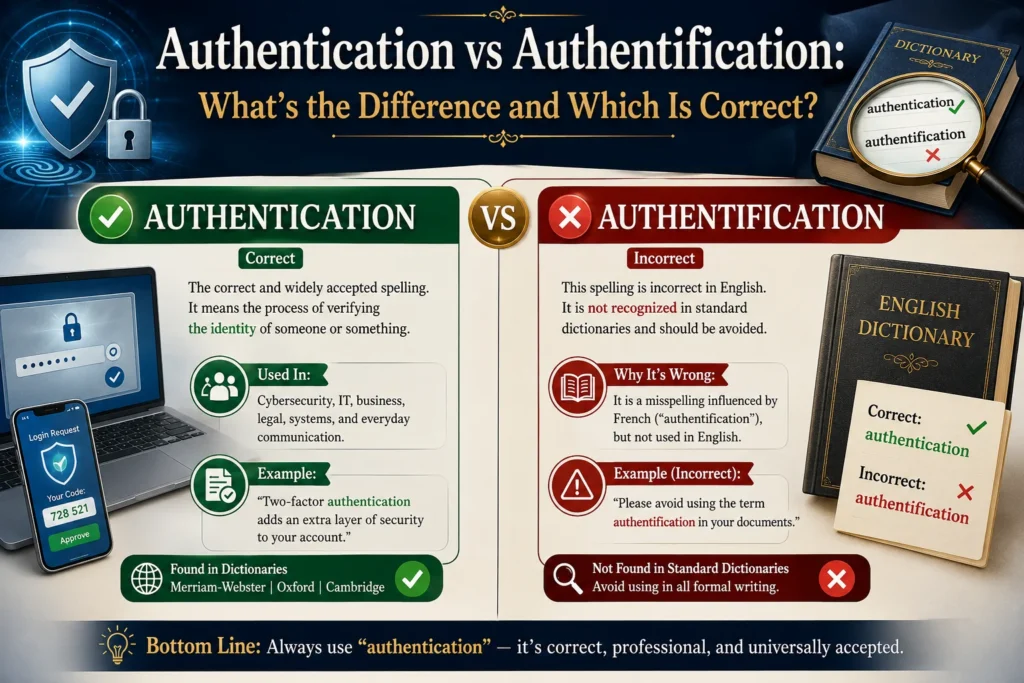
Authentication vs Authentification often confuses writers because both words look alike, but only one is the accepted English spelling today for secure identity checks.Many people search or have searched for Authentication vs Authentification because the two terms and words look nearly identical and sometimes seem interchangeable. This comparison creates confusion, and the confusion exists because of translation, translation influences, and the history of the English language. From my own experience reading technical documents, academic papers, business documents, legal texts, translated content, and cybersecurity guides, I have seen this pair many times. This guide will help you learn the difference, improve your understanding, and explain authentication means clearly. Authentication is the accepted English term, the standard, and widely accepted in modern English, while authentification is much less common. Choosing the correct word matters when studying English, writing professionally, and improving your grammar, spelling, vocabulary, and terminology.
In cybersecurity, authentication is the process of identity verification, verification, proving, or verifying that someone or something is real and true. It plays a key role in modern digital security, digital security, and overall security by protecting identity and building trustworthiness. Whether you are logging in to a website, using a login, entering a password, or providing credentials for secure access, authentication keeps your information safe both online and offline. These concepts are among the most important concepts on the internet, and cyber security frameworks, frameworks, and many documents use real-life examples to explain their authentic meaning.
For learners, advanced learners, and anyone working at school or work, this distinction becomes easy to understand through logic and the influence of English, French, Latin, and Greek. Although websites, emails, exams, and everyday communication may show both spellings, only one is the recognised word in modern usage. Using clear terms helps you avoid mistakes, write better sentences, and build confidence in writing. Always use reliable content and remember that authentification is generally the wrong choice in standard English.
Authentication vs Authentification at a Glance
Before diving deeper, here’s a quick comparison.
| Feature | Authentication | Authentification |
| Standard English Word | Yes | Rarely used |
| Found in Dictionaries | Yes | Limited usage |
| Common in Cybersecurity | Yes | No |
| Used in Business Writing | Yes | Rarely |
| Accepted by Style Guides | Yes | Generally avoided |
| Common in Technical Documentation | Yes | Occasionally through translations |
The Short Answer
If you’re writing in English, use authentication.
While authentification has historical and linguistic roots, it is not the preferred term in modern English. Most native speakers, editors, academics, and cybersecurity professionals use authentication almost exclusively.
Think of it this way:
Authentication is the standard English term. Authentification is primarily a linguistic variation influenced by other languages.
What Does Authentication Mean?
The word authentication refers to the process of proving that something is genuine, valid, or legitimate.
In everyday situations, authentication helps confirm that a person, object, document, or digital account is exactly what it claims to be.
Definition of Authentication
Authentication is:
The act of verifying identity, ownership, origin, or legitimacy.
The concept appears in many fields, including:
- Cybersecurity
- Banking
- Government services
- Law
- Education
- Art appraisal
- Document verification
The core idea remains the same.
Something claims to be genuine.
Authentication verifies that claim.
Authentication in Everyday Language
Many people associate authentication with passwords and login screens. Yet the concept existed long before computers.
For example:
- A museum authenticates a painting.
- A bank authenticates a customer’s identity.
- A university authenticates academic records.
- A government office authenticates official documents.
- A collector authenticates a rare autograph.
In every case, the goal is verification.
Authentication Examples in Sentences
Here are some practical examples:
- The bank requires authentication before approving a transfer.
- Multi-factor authentication protects online accounts.
- Experts performed authentication tests on the artwork.
- The university completed authentication of the student’s diploma.
- The system failed authentication because the password was incorrect.
Notice how natural the word sounds in each context.
That’s one reason it dominates modern English usage.
Is Authentification a Real Word?
One of the most common questions is whether authentification is actually a legitimate word.
The answer is more nuanced than many people expect.
Dictionary Status of Authentification
Authentification has appeared in some historical dictionaries and linguistic references.
However, it is far less common than authentication.
Modern English dictionaries overwhelmingly favor authentication as the primary term.
As a result:
- Authentication appears frequently.
- Authentification appears rarely.
- Most style guides recommend authentication.
- Professional writers almost always choose authentication.
Why Some People Use Authentification
Several factors contribute to the confusion.
Translation Influences
Many languages contain words closely resembling authentification.
For example, French uses:
Authentification
When content gets translated into English, writers sometimes preserve the original structure.
International Technical Documentation
Global companies often translate manuals and software documentation.
In some cases, translation software or non-native writers introduce authentification into English documents.
Historical Language Development
English borrowed vocabulary from numerous languages.
During that process, multiple word forms occasionally emerged.
Authentication ultimately became the dominant form.
Is Authentification Incorrect?
Not necessarily.
It exists in certain linguistic contexts.
However, it is generally considered nonstandard for modern English writing.
If your audience speaks English, choose authentication.
That choice improves clarity and aligns with contemporary usage.
The Origin of Authentication and Authentification
Words have histories. Understanding those histories helps explain why these two terms look so similar.
Etymology of Authentication
Authentication traces its roots to ancient languages.
The journey includes:
- Greek: authentikos
- Late Latin influences
- Medieval language development
- Modern English adoption
The underlying meaning remained remarkably consistent.
It always related to genuineness, authority, legitimacy, and verification.
The French Influence Behind Authentification
French evolved a related term:
Authentification
Because English and French share many linguistic roots, the words appear nearly identical.
This similarity creates confusion among learners, translators, and professionals working in multilingual environments.
Why the Two Words Look So Similar
Languages constantly borrow from one another.
Sometimes one version becomes dominant while alternative forms survive in limited contexts.
Authentication won widespread acceptance in English.
Authentification remained more closely associated with French usage and occasional translations.
Why Authentication Became the Standard English Term
Language evolves through use.
The words people adopt most often eventually become standards.
That is exactly what happened with authentication.
Usage in Modern English
Today, authentication appears throughout:
- Academic journals
- Technology publications
- Cybersecurity standards
- Government documents
- Legal writing
- Business communication
A quick review of modern professional literature reveals overwhelming preference for authentication.
Adoption Across Industries
Authentication became the standard because industries needed a consistent term.
Technology
Software developers use authentication daily.
Examples include:
- User authentication
- Password authentication
- Device authentication
- Identity authentication
Finance
Banks authenticate:
- Customers
- Transactions
- Digital signatures
- Payment requests
Healthcare
Medical systems authenticate:
- Staff members
- Patients
- Prescriptions
- Medical records
Government
Governments authenticate:
- Passports
- Licenses
- Identity documents
- Citizen accounts
The consistency of usage strengthened the word’s position.
Preferred Usage by Professional Style Guides
Editors value consistency.
Because authentication became the dominant form, major publishers and organizations adopted it as their standard.
That decision reinforced its widespread acceptance.
Authentication in Cybersecurity
Cybersecurity transformed authentication from a specialized term into a household word.
Every time you log into an account, authentication is taking place.
What Authentication Means in Information Security
In cybersecurity, authentication verifies that users are who they claim to be.
Without authentication, systems would have no reliable way to distinguish legitimate users from attackers.
The process typically occurs before access is granted.
A simplified flow looks like this:
User Requests Access
↓
Identity Verification
↓
Authentication Success?
↓ ↓
Yes No
↓ ↓
Grant Access Deny Access
Authentication forms the first line of defense against unauthorized access.
Authentication vs Authorization
Many people confuse these concepts.
They are related but different.
| Authentication | Authorization |
| Verifies identity | Verifies permissions |
| Answers “Who are you?” | Answers “What can you do?” |
| Happens first | Happens second |
| Confirms legitimacy | Determines access rights |
Example:
You enter a password to access your company account.
That’s authentication.
The system allows you to view payroll files.
That’s authorization.
Authentication vs Verification
Verification and authentication overlap.
However, they are not always identical.
Authentication focuses specifically on confirming identity or legitimacy.
Verification can refer to confirming any type of information.
For example:
- Verifying an email address
- Verifying data accuracy
- Verifying calculations
Authentication is a more specialized form of verification.
Common Types of Authentication
Modern organizations use several authentication methods.
Each offers different advantages and security levels.
Password-Based Authentication
This remains the most familiar method.
Users provide:
- Username
- Password
Advantages:
- Easy to implement
- Low cost
- Familiar to users
Limitations:
- Weak passwords
- Password reuse
- Phishing attacks
- Credential theft
Passwords alone no longer provide sufficient protection for many systems.
Multi-Factor Authentication (MFA)
MFA requires multiple forms of proof.
Typically, users must provide at least two or more authentication factors.
Examples include:
- Password
- Mobile app approval
- Security key
- Biometric scan
Benefits include:
- Stronger protection
- Reduced account takeover risk
- Better compliance support
Many security experts consider MFA essential rather than optional.
Two-Factor Authentication (2FA)
2FA represents a subset of MFA.
Common examples include:
- Password plus SMS code
- Password plus authenticator app
- Password plus fingerprint
Even if attackers steal a password, they still need the second factor.
That dramatically improves security.
Biometric Authentication
Biometrics rely on physical characteristics.
Examples include:
- Fingerprints
- Facial recognition
- Retina scans
- Voice recognition
Advantages:
- Convenience
- Fast verification
- Difficult to duplicate
Challenges:
- Privacy concerns
- Hardware requirements
- False positives
Biometrics continue to expand across consumer and enterprise technology.
Certificate-Based Authentication
Organizations often use digital certificates to verify devices and users.
Benefits include:
- Strong cryptographic protection
- Reduced password dependency
- Enterprise scalability
Large corporations frequently rely on certificate-based systems.
Single Sign-On (SSO)
SSO allows users to authenticate once and access multiple applications.
Examples include workplace portals where one login unlocks several services.
Advantages include:
- Better user experience
- Reduced password fatigue
- Improved productivity
However, strong security controls remain essential because a compromised SSO account can affect multiple systems.
Conclusion
Understanding Authentication vs Authentification helps you choose the correct word with confidence. While the two spellings may look similar, authentication is the standard, widely accepted term in modern English and is used in cyber security, business documents, legal texts, and everyday writing. Knowing this difference improves your grammar, strengthens your professional writing, and helps you avoid common spelling mistakes. Whether you’re a student, writer, or IT professional, using the right term makes your communication more accurate and trustworthy.
FAQs
Q1. What is the difference between Authentication and Authentification?
Authentication is the correct and widely accepted English term for verifying a person’s identity or proving something is genuine. Authentification is much less common in modern English and is usually seen because of translation or historical language influences.
Q2. Is authentification a real English word?
Yes, authentification exists historically and appears in some dictionaries, but it is rarely used in modern English. In almost every professional, technical, and academic context, authentication is the preferred choice.
Q3. Why is authentication important in cybersecurity?
In cyber security, authentication verifies a user’s identity before granting secure access to systems, websites, or applications. It helps protect sensitive information by using methods such as passwords, login credentials, or other verification techniques.
Q4. Why do people confuse these two words?
The confusion happens because both words have similar spellings, share the same root, and may appear in translated content or older texts. Language influences from French and other languages also contribute to the misunderstanding.
Q5. Which word should I use in professional writing?
You should almost always use authentication in professional writing, academic papers, technical documents, emails, and business communication. It is the recognized standard in modern English and is understood by readers worldwide.

David Williams is a Grammar Expert who helps people understand English in a simple and practical way.
He writes short, clear lessons for GrammarVerb so learners can speak and write with confidence.
His mission is to make English grammar easy, useful, and stress-free for everyone.