
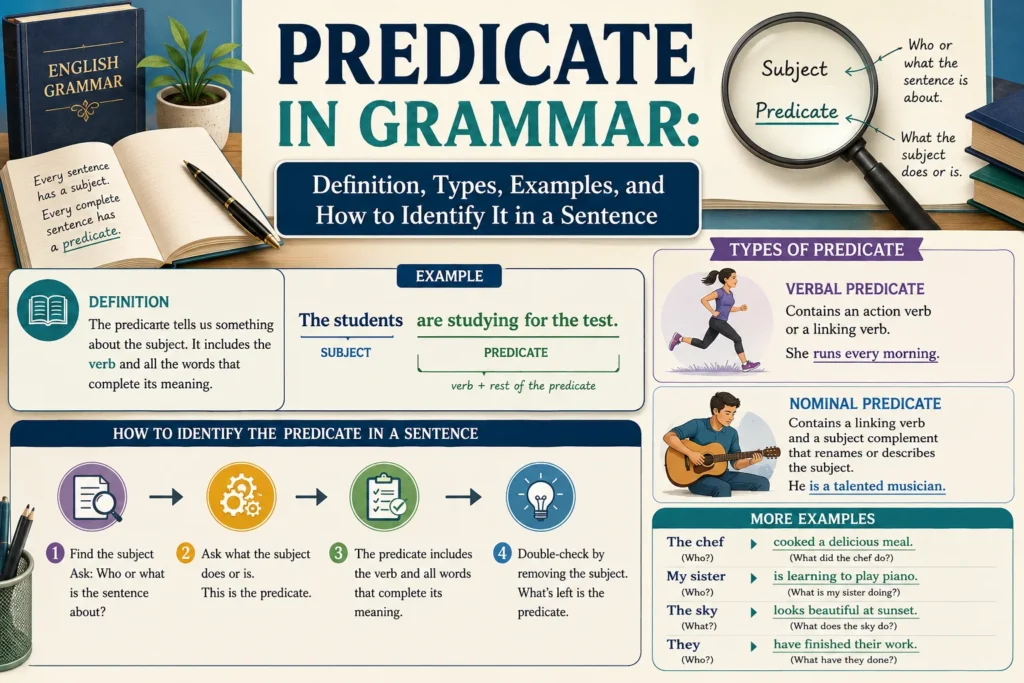
A solid grasp of the predicate of a sentence builds stronger grammar skills, improves writing, explains predicate meaning clearly, and helps avoid common mistakes. A good understanding of the predicate makes grammar easier to learn and improves your grammar skills. This article and guide define, explain, and simplify the predicate meaning, predicate means, and definition with simple examples. A predicate is the part of a sentence that predicate tells us what the subject does, is, has, thinks, feels, or experiences. Every complete sentence contains two essential parts: the subject and the predicate. The subject tells us who or what the subject of a sentence is about, while the predicate gives more about the subject. If you want to understand predicate ideas, build stronger sentences, and learn better, this knowledge will help. From my own learning and writing experience, this simple idea has improved my communication and helped me avoid common, grammatical, common mistakes, common grammatical mistakes, and many grammar errors.
The verb is the center of every predicate, and each one has at least a single verb. It may include an action, state, object, direct object, direct objects, indirect object, noun, or phrase that receive the actions involved. For example, He cleaned cleaned his room, where room is the direct object. They drank drank tea, and tea receives the action. We gave gave a gift, where gift is the direct object. Sarah writes writes novels, and novels complete the meaning. Another example is gave her brother a new book, where brother is the indirect object, while new book or book is the direct object. Every clause completes the thought, avoids an unfinished sentence, and provides the information needed for correct sentence completion.
As your education in English grammar and language learning grows, knowing the rules, types, and types of predicates will improve your work with sentence structure, sentence components, grammatical structure, and syntax. Different definitions and predicate examples make the meaning easier to remember because every complete sentences example explains everything clearly. Regular practice, practical exercises, and exercises also helps every student, teacher, writer, and English learner use a predicate correctly in any language.
What Is a Predicate?
A predicate is the part of a sentence that tells something about the subject. It contains the verb and often includes other words that complete or describe the action.
Simply put:
The predicate explains what the subject is doing or being.
Consider this sentence:
The dog barked loudly.
- Subject: The dog
- Predicate: barked loudly
The predicate tells us what the dog did.
Predicate Definition
In English grammar, a predicate consists of the verb and all the words that modify, complete, or describe the action or state expressed by that verb.
Predicates can describe:
- Actions
- Conditions
- States of being
- Feelings
- Possession
- Experiences
Examples of Predicates
| Sentence | Subject | Predicate |
| John runs every morning. | John | runs every morning |
| The flowers are beautiful. | The flowers | are beautiful |
| We finished the project yesterday. | We | finished the project yesterday |
| My brother plays guitar. | My brother | plays guitar |
Why Every Complete Sentence Needs a Predicate
A predicate gives meaning to the subject.
Look at this example:
The teacher
This isn’t a complete sentence.
Now add a predicate:
The teacher explained the lesson clearly.
Now the sentence expresses a complete thought.
Without predicates, communication would break down. Readers would know who or what you’re talking about but wouldn’t know anything important about that subject.
Functions of a Predicate
Predicates can:
- Show action
- Express existence
- Describe a condition
- Reveal emotions
- Identify a person or thing
- Connect ideas
For example:
| Function | Example |
| Action | Emma danced gracefully. |
| State of being | Emma is tired. |
| Feeling | Emma feels excited. |
| Identification | Emma is a teacher. |
Subject vs. Predicate: Understanding the Difference
Many students confuse subjects and predicates. Fortunately, the distinction is simple.
Subject
The subject tells who or what the sentence discusses.
Predicate
The predicate tells what the subject does or is.
Quick Comparison
| Subject | Predicate |
| The cat | slept on the couch |
| My parents | traveled to Italy |
| The building | collapsed during the storm |
| Students | completed the assignment |
Example Breakdown
Sentence:
The young athlete won the championship.
| Part | Words |
| Subject | The young athlete |
| Predicate | won the championship |
Think of the subject as the star of the show. The predicate tells the audience what happens to that star.
The Core Components of a Predicate
Predicates often contain more than a single verb.
Several elements can appear inside a predicate.
Verbs: The Heart of Every Predicate
Every predicate contains at least one verb.
Without a verb, a predicate cannot exist.
Action Verbs
Action verbs show what the subject does.
Examples:
- jump
- write
- swim
- drive
- sing
Sentence:
The child jumped over the puddle.
Predicate:
jumped over the puddle
Linking Verbs
Linking verbs connect the subject to more information.
Common linking verbs:
- is
- am
- are
- was
- were
- seem
- become
- appear
Example:
The soup smells delicious.
Predicate:
smells delicious
Helping Verbs
Helping verbs work alongside main verbs.
Examples:
- has
- have
- had
- can
- could
- will
- would
- should
Sentence:
They have completed the project.
Predicate:
have completed the project
Words and Phrases That Can Appear in a Predicate
A predicate often contains more than just a verb.
Additional elements provide clarity and detail.
Direct Objects
Receive the action of the verb.
Example:
Maria baked a cake.
Predicate:
baked a cake
Direct object:
cake
Indirect Objects
Receive the direct object.
Example:
Maria gave her friend a gift.
Indirect object:
friend
Complements
Complete the meaning of linking verbs.
Example:
The sky became dark.
Complement:
dark
Modifiers
Add extra detail.
Examples:
- quickly
- carefully
- yesterday
- at home
Sentence:
The team practiced intensely yesterday.
Prepositional Phrases
Provide context.
Examples:
- in the garden
- after school
- during the meeting
Sentence:
The children played in the garden.
How Predicates Expand Sentence Meaning
Compare these examples:
Basic Predicate
The baby slept.
Expanded Predicate
The baby slept peacefully through the night in her crib.
The second sentence paints a clearer picture because the predicate includes descriptive details.
Strong writing often depends on well-developed predicates.
Types of Predicates in English Grammar
English grammar includes several predicate types.
Each serves a slightly different purpose.
Simple Predicate
The simple predicate consists only of the main verb or verb phrase.
Definition of a Simple Predicate
A simple predicate excludes modifiers and additional information.
It focuses only on the essential verb.
Examples
| Sentence | Simple Predicate |
| The bird flew across the lake. | flew |
| Sarah has finished her homework. | has finished |
| We were waiting outside. | were waiting |
How to Identify the Simple Predicate
Follow these steps:
- Find the subject.
- Locate the main verb.
- Remove extra descriptive words.
- The remaining verb is the simple predicate.
Example:
The talented musician performed beautifully on stage.
Simple predicate:
performed
Complete Predicate
The complete predicate includes the verb and every word that relates to it.
Definition of a Complete Predicate
Everything in the sentence that isn’t part of the subject belongs to the complete predicate.
Examples
| Sentence | Complete Predicate |
| The boy kicked the ball. | kicked the ball |
| The scientist discovered a new species. | discovered a new species |
| My sister baked cookies for the party. | baked cookies for the party |
Elements Included in a Complete Predicate
A complete predicate may contain:
- Main verb
- Helping verbs
- Objects
- Complements
- Adverbs
- Prepositional phrases
Compound Predicate
A compound predicate occurs when one subject performs two or more actions.
Definition of a Compound Predicate
A compound predicate contains multiple verbs connected by conjunctions.
Examples
The dog barked and chased the squirrel.
Compound predicate:
barked and chased the squirrel
Sarah studied for the exam and completed her assignment.
Compound predicate:
studied for the exam and completed her assignment
Why Writers Use Compound Predicates
Benefits include:
- Reducing repetition
- Improving sentence flow
- Increasing clarity
- Creating smoother transitions
Instead of writing:
David opened the door. David entered the room.
You can write:
David opened the door and entered the room.
Linking Verbs and Predicate Complements
Linking verbs often require complements to complete meaning.
These complements fall into two main categories.
What Is a Predicate Nominative?
A predicate nominative renames or identifies the subject.
It follows a linking verb.
Examples
Sarah is a doctor.
Predicate nominative:
doctor
Mark became the captain.
Predicate nominative:
captain
How Predicate Nominatives Work
The subject and predicate nominative refer to the same person or thing.
| Subject | Predicate Nominative |
| Sarah | doctor |
| Mark | captain |
| Olivia | president |
What Is a Predicate Adjective?
A predicate adjective describes the subject after a linking verb.
Examples
The weather is pleasant.
Predicate adjective:
pleasant
The students seem excited.
Predicate adjective:
excited
Common Predicate Adjectives
Examples include:
- happy
- tired
- strong
- intelligent
- nervous
- beautiful
Predicate Nominative vs. Predicate Adjective
Students often confuse these concepts.
Here’s a simple comparison.
| Feature | Predicate Nominative | Predicate Adjective |
| Renames subject | Yes | No |
| Describes subject | No | Yes |
| Usually a noun | Yes | No |
| Usually an adjective | No | Yes |
Examples
| Sentence | Type |
| Emma is a teacher. | Predicate Nominative |
| Emma is talented. | Predicate Adjective |
How to Identify the Predicate in Any Sentence
Finding predicates becomes easy with practice.
Step 1: Find the Subject
Ask:
Who or what is this sentence about?
Step 2: Locate the Verb
Find the action or linking verb.
Step 3: Determine Predicate Type
Decide whether it’s:
- Simple predicate
- Complete predicate
- Compound predicate
Step 4: Include Related Words
For complete predicates, include all words connected to the verb.
Quick Predicate Identification Formula
Use this shortcut:
Subject + Everything Else = Predicate
Example:
The students completed their research project before Friday.
Subject:
The students
Predicate:
completed their research project before Friday
Predicate Examples by Sentence Type
Predicates appear in every sentence type.
Declarative Sentences
Make statements.
Example:
The company launched a new product.
Predicate:
launched a new product
Interrogative Sentences
Ask questions.
Example:
Did you finish your homework?
Predicate:
did finish your homework
Imperative Sentences
Give commands.
Example:
Close the window.
Predicate:
close the window
The subject “you” is implied.
Exclamatory Sentences
Express strong emotion.
Example:
What a fantastic performance that was!
Predicate:
was
Predicate Examples Table
| Sentence | Subject | Predicate Type | Predicate |
| The dog barked loudly. | The dog | Complete | barked loudly |
| Emily sings beautifully. | Emily | Complete | sings beautifully |
| We traveled and explored. | We | Compound | traveled and explored |
| The soup tastes wonderful. | The soup | Complete | tastes wonderful |
Common Predicate Mistakes
Even advanced writers make predicate errors.
Understanding them helps improve sentence accuracy.
Confusing Predicates with Verbs
A verb is part of a predicate.
A predicate is often much larger.
Example:
The athlete trained hard every day.
Verb:
trained
Predicate:
trained hard every day
Misidentifying Complete Predicates
Writers sometimes exclude important words.
Incorrect:
Predicate = “won”
Correct:
Predicate = “won the championship last weekend”
Overlooking Compound Predicates
Example:
The manager reviewed the report and approved the budget.
Many learners identify only the first action.
The full compound predicate includes both verbs.
Mistaking Predicate Complements for Objects
Consider:
The sky became dark.
“Dark” is not an object.
It is a predicate adjective.
Common Student Errors
- Ignoring helping verbs
- Missing compound verbs
- Confusing subjects and predicates
- Overlooking modifiers
- Mislabeling complements
Predicate vs. Other Grammar Terms
Several grammar concepts appear similar to predicates.
Let’s separate them clearly.
Predicate vs. Verb
| Predicate | Verb |
| Larger grammatical unit | Single action/state word |
| Contains verb | Is part of predicate |
| May include objects and modifiers | Does not |
Predicate vs. Object
| Predicate | Object |
| Contains action | Receives action |
| Includes verb | Does not contain verb |
Example:
Lisa wrote a letter.
Predicate:
wrote a letter
Object:
letter
Predicate vs. Clause
A clause contains:
- Subject
- Predicate
A predicate is only one part of a clause.
Predicate vs. Phrase
A phrase lacks both a subject and a predicate.
Example:
under the bridge
This is a phrase, not a sentence.
Quick Comparison Table
| Term | Contains Verb | Contains Subject |
| Predicate | Yes | No |
| Clause | Yes | Yes |
| Phrase | Usually No | No |
| Object | No | No |
Predicate Exercises and Practice Sentences
Practice builds confidence.
Identify the predicate in each sentence.
Exercise Set 1
- The teacher explained the lesson.
- Birds migrate every winter.
- The chef prepared a delicious meal.
Answers
| Sentence | Predicate |
| The teacher explained the lesson. | explained the lesson |
| Birds migrate every winter. | migrate every winter |
| The chef prepared a delicious meal. | prepared a delicious meal |
Intermediate Practice
- The athlete trained daily and competed internationally.
- My neighbors have renovated their house.
- The weather became extremely cold overnight.
Answers
| Sentence | Predicate |
| The athlete trained daily and competed internationally. | trained daily and competed internationally |
| My neighbors have renovated their house. | have renovated their house |
| The weather became extremely cold overnight. | became extremely cold overnight |
Advanced Sentence Analysis
Sentence:
The experienced researcher carefully analyzed the data and presented her findings during the conference.
Subject:
The experienced researcher
Compound predicate:
carefully analyzed the data and presented her findings during the conference
Predicate Examples From Real Writing
Predicates appear everywhere.
Understanding them improves reading comprehension and writing quality.
Everyday Conversation
Examples:
- I need some coffee.
- We should leave now.
- The meeting starts at noon.
Academic Writing
Examples:
- The study examined multiple variables.
- Researchers collected data over six months.
- The results support the hypothesis.
Academic writing often relies on precise predicates to communicate findings clearly.
Literature
Authors use powerful predicates to create vivid imagery.
Example:
The wind howled through the trees.
The predicate creates movement and atmosphere.
Strong predicates bring writing to life.
Conclusion
Understanding the predicate-of-a-sentence is one of the easiest ways to improve your English grammar and build stronger sentences. Every complete sentence needs a subject and a predicate that work together to express a complete thought. Once you know how the verb, object, and other sentence parts fit into the predicate, writing becomes clearer and more natural. With regular practice, simple examples, and careful attention to sentence structure, you can avoid common grammar mistakes and communicate with confidence.
FAQs
Q1. What is a predicate-of-a-sentence?
A predicate-of-a-sentence is the part of a sentence that tells what the subject does, is, has, thinks, feels, or experiences. It always includes at least one verb.
Q2. Can a predicate have more than one word?
Yes. A predicate can be a single verb or a group of words that includes the verb along with an object, phrase, or other details that complete the meaning of the sentence.
Q3. What are the main types of predicates?
The most common types of predicates are the simple predicate, complete predicate, and compound predicate. Each one adds different levels of detail to a sentence.
Q4. How can I identify the predicate in a sentence?
First, find the subject. Then ask, “What does the subject do?” or “What is being said about the subject?” The answer is the predicate.
Q5. Why is learning predicates important?
Learning predicates helps you write clearer sentences, improve your grammar skills, avoid common mistakes, and communicate more effectively in both speaking and writing.

I translate “complicated grammar” into simple, visual language that any person can learn fast. I believe English confidence is not about perfection — it’s about clarity and impact. Every guide I publish is designed to help you speak smarter, write sharper, and feel more powerful in English.